Drones have gone far beyond niche gadgets and become essential tools in practically all sectors. On top of that, the real revolution, however, takes place when artificial intelligence, or AI, steps into the “cockpit”. The reason why AI is a game-changer for next-gen drone technology is that it can elevate the aspects of autonomy, intelligence, and operational efficiency to a whole new level.
By allowing drones to learn, adjust, and react to the ever-changing environment, AI converts the ordinary flying devices into intelligent aerial partners. The applications of AI-based drones are almost limitless, as they are changing the face of the skies. Whether it be precision agriculture or smart logistics, the sky is not the limit for them, thus providing decision-makers with unimaginable tools at hand.
AI-Powered Drones: Transforming Industries
Artificial intelligence (AI) integration in the unmanned aerial vehicle (UAV) sector is encouraging remarkable breakthroughs in various fields, including medicine, agriculture, logistics, and ecological monitoring.
Autonomous delivery drones of Zipline utilize AI algorithms for the optimization of the routes and to guarantee the punctuality in the arrival of medicines to remote areas. AI-powered drones scan the farm’s soil health, identify crop diseases at early stages, and monitor irrigation efficiency, enabling farmers to use resources in a highly targeted way.
In the same way, nature’s drone AI is capturing deforestation and monitoring water quality by keeping it in real-time, thus turning nature into an open data source, which, before, was hardly even imaginable.
Autonomous Navigation and Smart Decision-Making
The functioning of the traditional unmanned aerial vehicles (UAVs) is highly dependent upon routes that are pre-set, causing a lack of flexibility and response to the changing situation. AI transforms this model by allowing dynamic decision-making and adaptive flight behavior.
Drones equipped with advanced computer vision systems detect obstacles in real-time, foresee potential dangers, and automatically adjust their flight routes. In disaster areas, AI drones deftly navigate rugged debris to locate survivors, eliminating the need for human intervention while maintaining high speed and accuracy.
AI-Enhanced Data Analytics
Companies can provide customers with an accurate timetable and respond quickly to any unexpected situations. AI-powered data analytics take this data and turn it into actionable insights, thus decision-making gets smarter and broader. Healthcare, for example, where AI technology can rapidly map disaster zones and pinpoint the locations that require the most urgent medical help, is one such case.
AI drones drive progress in construction by continuously monitoring the site, reducing rework and enhancing safety compliance. This smart move enables businesses to act proactively, converting raw data into a strategic asset.
Case Study: AI Drones in Logistics
FedEx and Amazon are already working extensively on drones for delivery purposes, with AI as their ally. By integrating AI technology, they can not only plan the quickest routes but also predict weather impacts and automate the whole fleet. Consequently, this would lead to delivery times being shortened, fuel consumption being minimized, and operational costs being cut.
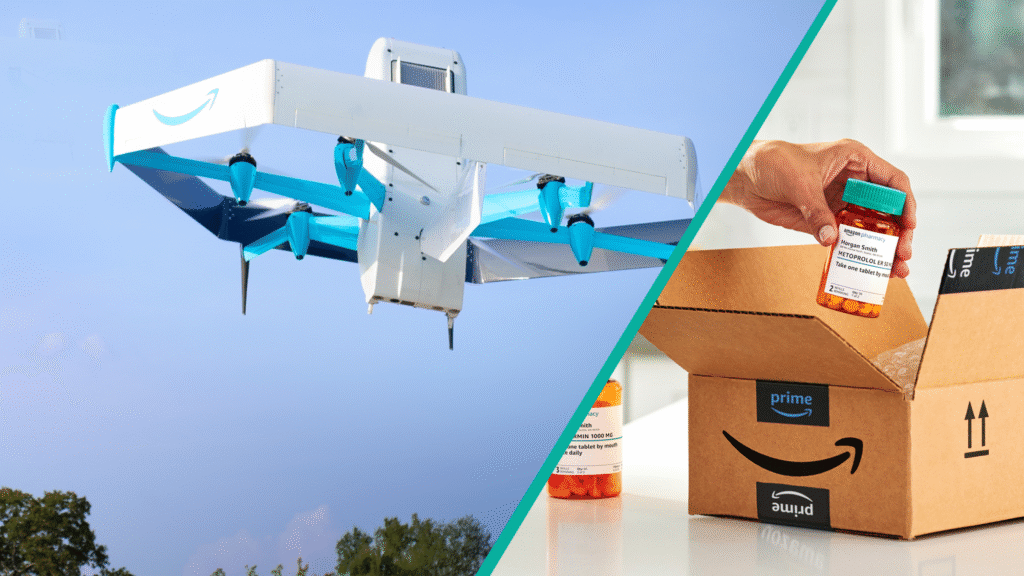
It has been stated that delivery efficiency in AI-powered drone applications has seen an increase of 20% in pilot programs. As another win for AI technology, drones are equipped for the easy tracking of deliveries.
This allows companies to provide customers with an accurate timetable and respond rapidly to any unexpected situations. They create a smooth link between technology and service providers beyond the parameters of efficiency.
Security and Surveillance Applications
AI-powered drones revolutionize security practices by expanding their monitoring capabilities. Technologically advanced with facial recognition, object detection, and predictive analytics, drones are capable of identifying potential risks more quickly than traditional systems. During the time of mass gatherings, AI surveillance drones keep an eye on the crowd, pinpoint abnormal behavior, and instantly notify the authorities.
In the case of border control, without human assistance, AI drones can patrol large tracts of land, locate illegal activities, and offer real-time intelligence for the safety as well as operations area expansion.
The Ethical and Regulatory Landscape
Just the utilization of AI, ethics, and legislation will be central to the question of the responsible use of the drone. Means of guaranteeing privacy, data protection, and safe AI decisions are among the highest priorities.
Executives of the industry promote the open AI model, ethical design, and interaction of authors working together to find a way to achieve a balance between innovation and social responsibility.
Regulators in the U.S. and Europe are actively working on regulations for the management of airspace, the safety of drones, and data usage that will ensure AI-powered drones work within the set legal and ethical limits.
The Road Ahead
Indeed, the development of AI drones has a bright and promising future. Technologically advanced but individually dependent MICsights could carry out simultaneously five different activities. One could have been a natural disaster reaction, while ecological observation, logistics, and infrastructure inspection would have also been part.
AI keeps on speeding up the process of its evolution, resulting in the continual growth of the drones’ smartness, adaptiveness, and indispensability for diverse needs.
A sensible question that the decision-making team should pose to themselves is this:
In what way could our organization implement AI drones to achieve efficiency betterment, safety reinforcement, and vaulting into new business values?
The potential is immense, and the earliest adopters will be rewarded with a substantial competitive advantage.
Soaring Beyond Boundaries
AI is the driving force that transforms drones from tools into intelligent partners. Why AI is the game-changer for next-gen drone technology lies in its power to create smarter, safer, and more efficient aerial solutions across industries.
As these innovations continue to evolve, drones will not only reach higher altitudes but also break new ground in redefining operational excellence.
Embracing AI in drone technology represents a bold step toward a future where imagination meets capability, and the skies are truly limitless.
FAQs
1. How does AI improve drone navigation?
AI enables real-time obstacle detection, adaptive flight decisions, and dynamic route planning, making drones safer and more autonomous in complex environments.
2. Can AI drones be used in agriculture?
Yes, AI drones monitor crop health, detect diseases early, optimize resource usage, and provide actionable insights that help farmers increase yield efficiently.
3. Are AI drones safe for public use?
Equipped with advanced AI algorithms, drones enhance safety by managing fleets autonomously, detecting obstacles, and complying with regulatory standards.
4. How do AI drones contribute to logistics?
AI drones optimize delivery routes, predict environmental impacts, and autonomously manage fleets, improving delivery efficiency and reducing operational costs.
5. What ethical considerations exist for AI drones?
Key considerations include privacy, responsible AI decision-making, transparent data usage, and regulatory compliance to ensure societal trust and safety.
Discover the future of AI, one insight at a time – stay informed, stay ahead with AI Tech Insights.
To share your insights, please write to us at sudipto@intentamplify.com.