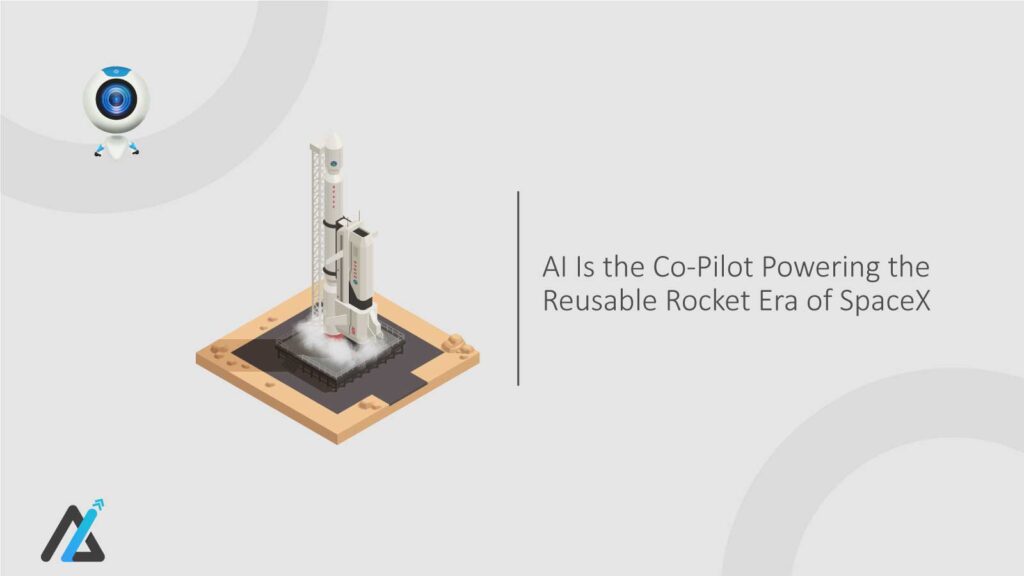
When SpaceX lands a Falcon 9 first stage with pinpoint precision, few consider the silent co-pilot behind the scenes: artificial intelligence. AI is the co-pilot powering the reusable rocket era of SpaceX, seamlessly integrating complex calculations, real-time adjustments, and predictive analytics.
This technological partnership is transforming space travel from experimental missions to a predictable, repeatable enterprise. In this article, we explore how AI is revolutionizing rocketry, what it means for the future of space exploration, and why decision-makers in tech and aerospace must pay attention.
Since the beginning of 2025, SpaceX has flown Falcon first-stage boosters for more than 384 re-flights and maintained a 100% mission success rate. Reusable rockets have become a reliable and economical option for agile access to space, and each re-flown booster saves the price of the launch by millions, creating commercial viability for frequent space access.
AI Plays a Vital Role
AI is an essential element to achieve this, and the AI systems are continuously monitoring rocket telemetry, optimizing landing trajectories, predicting component stress, etc. Co-pilot AI allows engineers to make adjustments in-flight on launch and insertion and landing trajectory, enabling repeated reuse while enforcing safety and reliability.
Economic Impacts and Operational Effects
The combination of reusable rockets with AI optimization capability has enabled SpaceX to fly high-frequency missions, including Starlink deployments, cargo resupply missions, and government contracts. By bypassing refurbishment intervals on boosters while maintaining reliability, AI enabled SpaceX to achieve a significant reduction in turnaround time, exponentially grow its operations, and speed up breaking barriers with projects like Starship, a mission to Mars, and eventually colonization of Mars.
The Rise of Reusable Rockets
SpaceX’s vision for reusability has fundamentally changed the economics of space. Traditional rockets are single-use, costing hundreds of millions per launch. By reusing the first stage of the Falcon 9, SpaceX has reduced launch costs dramatically. AI algorithms coordinate flight dynamics, engine throttling, and landing precision, making reusability not just a dream but a reliable operational reality.
This achievement underscores the effectiveness of SpaceX’s booster reusability program. By reusing boosters, SpaceX significantly reduces launch costs and turnaround times, contributing to the company’s ability to perform high-frequency launches. The successful recovery of boosters on all flights in 2023 demonstrates the reliability and efficiency of their reusability strategy.
Landing a 14-story rocket upright on a drone ship hundreds of miles offshore is no small feat. AI-powered flight computers continuously analyze sensor data, weather conditions, and engine performance to adjust trajectory in real time.
Dr. John M. Logsdon, a space policy expert, emphasized that “without AI, achieving consistent landings for reusable rockets would be virtually impossible”.
Real-Time Analytics for Safety
AI is not just optimizing efficiency; it’s enhancing safety. Each Falcon 9 flight generates terabytes of telemetry data. Machine learning algorithms process this information to predict component stress, identify potential anomalies, and recommend maintenance schedules. This predictive capability ensures that rockets are ready for reuse, reducing both costs and the risk of mission failure.
Autonomous Decision-Making in Flight
Modern rockets operate in environments where split-second decisions are vital. AI systems act as an autonomous co-pilot, making thousands of micro-adjustments per second. From engine gimbaling to trajectory correction, AI ensures rockets stay on course even in the presence of unexpected variables.
Elon Musk has highlighted that these AI systems allow SpaceX to focus human expertise on mission planning and innovation rather than real-time flight adjustments.
Predictive Maintenance and Lifespan Extension
Machine learning models analyze historical flight data to anticipate wear and tear on engines and structural components. By predicting maintenance needs, AI extends the operational lifespan of rockets, further reducing costs and enabling a high cadence of launches.
This approach has been instrumental in supporting SpaceX’s ambitious schedule of multiple missions per month.
AI in Simulation and Testing
Before a single rocket leaves the launch pad, AI plays a critical role in simulation. Reinforcement learning algorithms model millions of possible flight scenarios, including extreme weather, component failure, and orbital dynamics. This virtual testing allows engineers to refine software and hardware designs with a level of detail previously unattainable. NASA’s Jet Propulsion Laboratory notes that simulation-based AI dramatically reduces trial-and-error in rocket development.
Human-Machine Collaboration
While AI handles real-time control and predictive analytics, human engineers remain at the center of decision-making. This collaboration ensures that ethical considerations, mission priorities, and innovative problem-solving remain grounded in human judgment. AI is the co-pilot, but humans chart the course.
Industry Implications
The integration of AI into rocket operations has implications far beyond SpaceX. Aerospace companies, defense contractors, and satellite operators are closely observing the results of AI-driven reusable rockets. Reduced launch costs and higher mission reliability open opportunities for new satellite services, deep-space exploration, and commercial space travel.
Future Prospects
Looking ahead, AI’s role in spaceflight will only grow. Advanced algorithms may enable fully autonomous interplanetary missions, optimizing fuel consumption, trajectory, and landing strategies on distant celestial bodies.
SpaceX’s development of Starship, a fully reusable spacecraft, will likely rely heavily on AI to manage its complex, multi-stage systems.
AI and the Next Frontier
AI is the co-pilot powering the reusable rocket era of SpaceX, transforming how humanity reaches space. From precision landings to predictive maintenance and real-time autonomous decision-making, AI ensures that space travel becomes more efficient, safe, and repeatable.
For AI tech leaders and innovators, understanding this integration offers insights into the future of autonomous systems, high-frequency operations, and the boundless potential of machine-human collaboration.
As reusable rockets pave the way for more ambitious missions, AI’s role as a co-pilot underscores the profound partnership between human ingenuity and artificial intelligence.
FAQs
1. How does AI assist in SpaceX rocket landings?
AI continuously adjusts trajectory, engine thrust, and flight control to ensure precision landings on drone ships or pads.
2. Can rockets fly autonomously without human input?
AI handles real-time adjustments, but humans oversee mission planning and critical decision-making.
3. How does AI improve rocket reusability?
Predictive analytics detect component wear, guide maintenance schedules, and extend rocket lifespan.
4. What role does AI play in satellite deployment?
AI monitors flight and trajectory, ensuring accurate satellite positioning for constellations like Starlink.
5. Will AI impact commercial space travel in the future?
Yes. AI enables safer, more efficient launches and landings, reducing costs and increasing mission reliability.
Discover the future of AI, one insight at a time – stay informed, stay ahead with AI Tech Insights.
To share your insights, please write to us at sudipto@intentamplify.com