
Decision-makers will be making big decisions in 2026 with a new partner: AI systems. It can solve more variables in seconds than groups were able to do in weeks. These revolutionary capabilities lie at the heart of transformative AI trends that are reshaping how companies forecast, make, and succeed. The reward is not speed alone: it is strategic clarity.
AI went from siloed deployments to full-scale organization-wide adoption. Autonomous agents execute multi-step processes, sovereign AI secures sensitive data locally, and predictive engines forecast market and supply chain changes. It’s the difference between making it or breaking it in the next economic cycle.
Transformative AI Trends in 2026 Command Urgent Attention
The revolutionary trends reshaping business in 2026 are more than just the product of AI technology; they’re an indication of how rapidly industries are reshaping themselves with it. In its State of AI report, McKinsey said that 72% of the most successful companies have deployed AI in at least one critical business process, while slightly over half had done so two years ago. The adoption rate is not decreasing; it is rising.
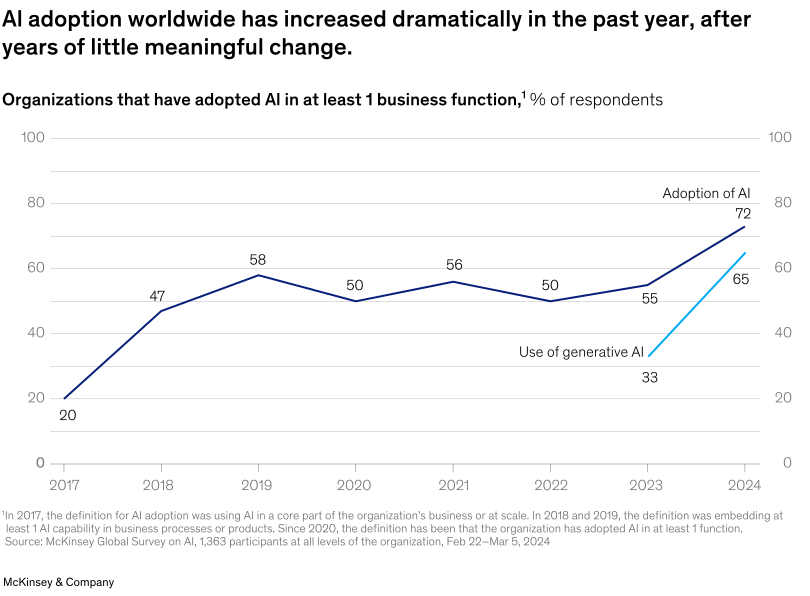
It is significant because the competitive disadvantage only continues to grow. Strategically investing in AI, companies are already reaping concrete benefits in productivity, revenue, and market share. In that regard, embracing AI is not a question of being on the same path as the revolution; it’s a question of defining your company’s place in an era where AI provides the operating platform.
1. Hyper-Personalization: AI’s New Gold Standard for Customer Engagement
In 2026, AI is poised to take personalization to a level that feels almost intuitive, the kind where brands anticipate your needs before you even realize them. This hyper-personalization will be fueled by advanced data analytics, behavioral modeling, and real-time sentiment analysis.
Instead of just recommending products you’ve browsed, AI will understand your mood, lifestyle changes, and even your micro-preferences. For businesses, this means higher conversion rates, deeper customer loyalty, and the ability to craft experiences that feel tailor-made for each individual. From retail to healthcare, companies will use AI to deliver perfectly tailored messaging, offers, and solutions without feeling “creepy.”
2. Autonomous Decision-Making: From Assistants to CEOs in the Cloud
While 2023–2025 positioned AI as a powerful assistant, 2026 will mark the shift to AI making independent, high-stakes business decisions and getting them right. Imagine AI systems that autonomously allocate budgets, fine-tune supply chains in real time, and negotiate contracts, all guided by pre-defined ethical and strategic parameters.
For example, in logistics, AI will decide the fastest, most cost-effective delivery routes during extreme weather events without human intervention. In finance, it will adjust investment portfolios in milliseconds in response to market shifts. This trend won’t replace human leadership, but it will redefine decision-making speed, accuracy, and scale.
3. Multimodal AI: Seeing, Hearing, and Understanding in 3D
Multimodal AI systems that can process and combine data from text, speech, images, video, and even sensor readings will become the norm in 2026. Businesses will no longer have to silo data into separate systems. Instead, AI will pull insights from a customer’s email, their social media posts, a product review video they recorded, and even biometric feedback from wearable devices, all in one unified analysis.
For sectors like healthcare, this could mean AI diagnosing conditions by combining patient speech analysis, medical imaging, and historical health data in seconds. In retail, that could look like a fully immersive shopping assistant that reads your facial expressions, listens to your tone, and taps into your purchase history to guide your decisions in real time.
4. Ethical AI Governance: The Business Mandate of the Decade
By 2026, AI ethics will no longer be optional; it will be a core business competency. Governments, regulators, and consumers alike are demanding transparency, fairness, and accountability in how AI is built and used. Businesses will need AI governance frameworks that ensure algorithms are unbiased, explainable, and compliant with evolving global laws.
The leaders in this space won’t just have compliance checklists; they’ll treat ethical AI as a brand differentiator. Expect to see organizations hiring “AI Ethics Officers” and integrating ethical audits into their quarterly business reviews. Customers will gravitate toward brands that can prove their AI is trustworthy, and investors will see ethical AI as a risk-mitigation strategy.
5. AI-Driven Sustainability: Smarter, Greener, Faster
AI in 2026 will be a key driver in the race toward net-zero goals and sustainable business practices. From optimizing energy usage in factories to predicting environmental impact before a new project launches, AI will help businesses meet sustainability targets faster and more cost-effectively.
In agriculture, AI will fine-tune irrigation schedules using real-time weather data, reducing water waste by up to 30%. In supply chains, AI will redesign routes to minimize carbon footprints while still meeting delivery deadlines. Sustainability will no longer be a PR checkbox; it will be an AI-enabled competitive advantage.
6. Human-AI Collaborative Work Models: The Rise of “Centaur Teams”
The fear that AI would “replace” humans is giving way to a new model of collaboration where human intuition and AI precision work side by side. In 2026, the most successful organizations will build “Centaur Teams”, humans augmented by AI to perform at superhuman levels.
For example, in legal services, AI will draft contracts while humans provide the strategic context. In creative industries, AI will generate content drafts, while humans add emotional nuance. In medicine, AI will handle diagnostics, freeing doctors to focus on patient empathy and care. This symbiosis will lead to better results, happier employees, and more innovative problem-solving.
Strategic Importance of AI Technology to Business Today
With the emerging competitive scenario, AI is a growth driver. Not only are companies automating functions by incorporating AI in their business, but they’re also creating new models of customer interaction, accelerating innovation, and competing more effectively with others. Starting from predictive analytics that identify nascent trends before the market even knows it’s there, to AI-driven personalization that tailors each interaction in real-time, the technology is transforming business models at their very core.
Innovative organizations are also using AI to bring siloed systems together and provide one source of truth for decision-making. It means marketing, sales, finance, operations, and customer service organizations all expanding from the same intelligent data foundation, enabling rapid response, enhanced collaboration, and enhanced forecasting.
The real difference is how far to embed AI capability into strategic goals. Those that can put AI into the DNA of their core business will be those who are leading their respective industries for years to come.
Turning Data into Foresight
The most revolutionary thing that AI brings to modern businesses is the capability to convert raw data into actionable foresight. In contrast to conventional analytics, which inform businesses about what has already happened in the past, AI-based predictive analytics enable companies to forecast what will most likely occur next and make plans accordingly.
For instance, a consumer goods retail chain can utilize AI models to predict cyclical variations in demand so that inventory matches consumer behavior to the finest detail. Likewise, a SaaS business can anticipate churn risk by spotting underlying patterns of user behavior, and customer success teams can intervene before the situation is out of control.
The actual game-changer, though, is the way these forecasts drive agility. No longer do business leaders have to trust their gut feeling or back-history trend; they can make intelligent, data-driven decisions at pace. And because the AI models recursively improve themselves with every new piece of data, the distance between prediction and outcome narrows and narrows.
In 2025 and beyond, businesses that embed predictive AI in their organizational strategy will enjoy an unmatched competitive advantage because, in business, knowing what comes next matters.
AI-Powered Predictive Intelligence: From Insights to Action
The future of AI business technology lies in predictive intelligence, where algorithms not only tell us what previously occurred but predict exactly what will occur next. It is redefining decision-making for companies across markets as diverse as retail forecasting stock shortages, and manufacturing forecasting machinery breakdowns in advance.
Today’s AI technology uses huge data sets and machine learning to look for faint patterns that are impossible for human experts to detect. AI, for instance, can review sales trends, social media comments, and trends altogether and suggest exact action, be it re-pricing, resource allocation, or assigning targeted campaigns at the point customers are most apt to respond.
The true value is bridging the gap between knowledge and action. Predictive AI not only advises leaders, but also inputs directly into business systems, triggering event chains that automatically unfold. This creates opportunities captured and risk reduced in real time, free from the latency that normally deprives companies of their competitive advantage.
By embedding predictive capabilities into everyday processes, businesses can operate with an almost sixth sense, anticipating customer needs, adapting strategies instantly, and optimizing outcomes at scale.
FAQs
1. What are the top AI trends expected to reshape businesses in 2026?
In 2026, AI is expected to advance in hyper-personalization, autonomous decision-making, multimodal AI, ethical AI governance, AI-driven sustainability, and human-AI collaborative work models. These trends will push industries toward more intelligent, adaptive, and customer-centric operations.
2. Which industries will benefit the most from these AI advancements?
While healthcare, finance, retail, manufacturing, and HR tech lead sectors from agriculture to entertainment are ready to harness AI. The key difference will be in how fast they adapt and integrate AI into their core strategies.
3. How will AI change the role of human employees by 2026?
AI will take over repetitive, data-heavy tasks, freeing employees to focus on strategic thinking, creativity, innovation, and human-centric problem-solving. Rather than replacing jobs outright, AI will reshape them, demanding new skills in AI literacy, critical thinking, and digital collaboration.
4. What are the biggest challenges in adopting AI for businesses?
Common challenges include data quality issues, integration with legacy systems, lack of skilled talent, and concerns about bias and ethics. Companies that invest early in data governance, upskilling, and transparent AI policies will be better positioned to overcome these hurdles.
5. Will small and mid-sized businesses (SMBs) also benefit from AI in 2026?
Absolutely. Affordable cloud AI lets SMBs automate marketing, support, supply chains, and analytics—without large in-house teams.
Discover the future of AI, one insight at a time – stay informed, stay ahead with AI Tech Insights.
To share your insights, please write to us at sudipto@intentamplify.com.