
Will autonomous vehicles replace human drivers by 2030? The thought of cars navigating city streets without human hands on the wheel is both exciting and unsettling. Imagine AI managing traffic lights, stop signs, and even rush-hour chaos. As advancements in machine learning, sensors, and real-time data continue to accelerate, the line between science fiction and everyday reality is shrinking. In this article, we’ll explore the technological breakthroughs, market trends, and societal shifts shaping the future of autonomous driving.
The Current Landscape: How Far Have We Come?
From AI-powered sensors to real-world pilot programs, innovators are already laying the foundations for a driverless future, setting the stage for broader adoption in the coming years.
Technological Milestones
Autonomous vehicles (AVs) are no longer a distant dream; they’re on the streets today, though in limited environments. According to McKinsey, companies like Waymo, Tesla, and Zoox have achieved Level 4 autonomy. This means cars can operate without human intervention under specific conditions.
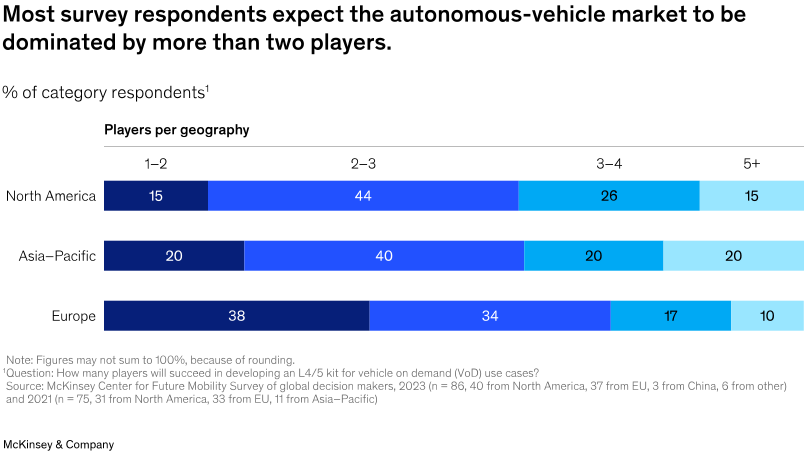
AI algorithms analyze large volumes of real-time data from radar systems, cameras, and LIDAR sensors to make snap decisions. Thousands of passengers have been securely carried by Waymo’s Phoenix pilot program, proving that autonomous technology can manage intricate urban settings.
In a similar sense, Tesla’s Full Self-Driving Beta demonstrates how consumer-facing AVs are improving constantly by using AI to traverse metropolitan streets and highways.
These milestones indicate that while full autonomy is not yet mainstream, the foundation for widespread adoption is solidly in place. The question remains how quickly these technologies will scale beyond test cities.
Market Adoption and Forecasts
The global autonomous vehicle market is projected to reach $428.3 billion by 2025, driven by innovations in semi-autonomous and fully autonomous vehicles, according to research by Precedence. Ride-hailing services, commercial fleets, and luxury vehicles are early adopters, while consumer demand grows as awareness and trust increase.
The best places for early integration are cities with sophisticated infrastructure and heavy traffic. There will be a slower rate of adoption in rural areas or places with less developed roadways. Fully autonomous vehicles are costly due to the need for sophisticated sensors, artificial intelligence (AI) systems, and redundant safety measures.
Despite these challenges, the pace of technological advancement and investment from major automakers suggests that hybrid solutions, where human drivers and autonomous systems coexist, will become increasingly common well before 2030.
Roadblocks to Full Autonomy
Even while driverless car technology is developing quickly, there are still obstacles in the way of widespread deployment. Beyond technical difficulties, laws, public confidence, and morality are important factors that influence how and when it can be incorporated into daily life.
Regulatory Landscape
Regulation is a significant bottleneck. Countries have different standards and timelines for AV deployment. For example, the UK government recently postponed approval for fully self-driving cars to the second half of 2027, according to the World Economic Forum.
Liability and insurance frameworks remain ambiguous. If an autonomous car causes an accident, who is responsible: the manufacturer, software developer, or “driver”? Clear legal guidelines are essential to avoid confusion and build public trust.
Until governments harmonize standards and define safety protocols, widespread adoption will face delays, even if the technology is ready.
Public Perception and Trust
Technology may be perfect, but human acceptability is still crucial. Although many individuals show interest in AVs, surveys reveal that a sizable percentage still feel apprehensive due to safety concerns. People frequently trust autonomous vehicles more with predictable interstate driving than with congested city streets full of bicyclists and pedestrians.
Campaigns for public education, pilot projects, and transparency are necessary to establish trust. If consumers have faith in AVs’ safety, dependability, and accountability, adoption may quicken.
Ethical and Legal Considerations
Autonomous vehicles must make decisions in milliseconds, sometimes life-or-death decisions. We cannot leave ethical questions, such as choosing between the lesser of two harms, to algorithms without oversight.
Additionally, insurers, lawmakers, and tech developers must clarify legal liability in case of accidents. This requires collaboration across multiple sectors to ensure that AV deployment aligns with societal values and safety expectations.
The Road to 2030: What Lies Ahead
Whether or not autonomous cars will transform transportation by 2030 is not the question; rather, it is how rapidly and in what ways. The transformation will be gradual rather than abrupt, with people and technology learning to live together on the road. Semi-autonomous features and hybrid models will be the main emphasis of early acceptance, laying the groundwork for a future with greater autonomy.
Gradual Integration
Rather than a sudden replacement of human drivers, a phased integration is likely. Hybrid models, where humans and autonomous systems share control, will dominate early adoption. For instance, semi-autonomous features such as adaptive cruise control, lane-keeping, and automated parking are already helping drivers transition to AV technology.
This incremental approach allows engineers to refine AI decision-making, monitor real-world performance, and gather public feedback before fully autonomous vehicles become commonplace.
Urban Mobility and Robotaxis
Urban areas will likely lead the AV revolution. Robotaxi services, driverless rides offered on demand, are already being tested in cities like Atlanta (Lyft and May Mobility).
These services aim to reduce congestion, increase convenience, and provide eco-friendly alternatives to private car ownership. In dense cities, AV fleets could handle large portions of urban transit, easing the daily commute and reshaping public transportation models.
Commercial and Freight Applications
Autonomous technology is also being adopted by the freight industry. For long-distance deliveries, businesses like Aurora and TuSimple are creating self-driving trucks. Early studies suggest that autonomous vehicles can significantly improve efficiency, lowering labor costs, optimizing fuel use, and enabling 24-hour operation.
Regulatory clearances and infrastructure improvements are necessary, nevertheless. For big AV trucks to coexist with human-driven vehicles, roads, traffic regulations, and safety standards must change. By 2030, logistics hubs might depend more on autonomous fleets to provide predictable routes, with people handling last-mile deliveries.
The Future of Work and Life with Self-Driving Vehicles
The development of driverless cars is expected to completely change how we live, work, and travel as 2030 draws near. Although it may not be possible to completely replace human drivers this decade, autonomous vehicles (AVs) will become more prevalent on the road, revolutionizing daily commutes, commercial logistics, and urban mobility.
Collaboration between innovators, regulators, and society will be necessary to achieve full autonomy, striking a balance between technological potential, moral obligation, and public confidence. The route ahead is more intelligent, secure, and dynamic than ever before; that much is clear.
Discover the future of AI, one insight at a time – stay informed, stay ahead with AI Tech Insights.
To share your insights, please write to us at sudipto@intentamplify.com.
FAQs
1. Will autonomous vehicles fully replace human drivers by 2030?
Full replacement is unlikely by 2030. Hybrid models with human-AI collaboration will dominate, while semi-autonomous features ease adoption.
2. What is the projected growth of the autonomous vehicle market by 2030?
The global AV market is expected to grow from USD 1,921.1B in 2023 to USD 13,632.4B by 2030, at a CAGR of 32.3%.
3. What challenges are hindering autonomous vehicle adoption?
Key challenges include regulatory hurdles, infrastructure gaps, public trust, and AI reliability in complex real-world conditions.
4. Which companies are leading in autonomous vehicle development?
Waymo, Tesla, and Zoox are leading, with pilot programs and semi-autonomous systems already in operation.
5. How will autonomous vehicles impact other industries?
AVs will transform insurance, logistics, and urban planning by shifting risk models, automating transport, and redesigning cities for smarter mobility.
Discover the future of AI, one insight at a time – stay informed, stay ahead with AI Tech Insights.
To share your insights, please write to us at sudipto@intentamplify.com.