Enterprise AI strategy has centered on augmentation. AI agents as copilots for developers. AI agents assisting analysts. Chat interfaces are layered onto existing workflows.
The real shift now underway is operational autonomy. Not software helping employees work faster, but software performing the work itself.
A fully agent-operated enterprise does not use AI as a tool. It uses AI for labor, coordination, and in certain contexts, management.
The important point for technical leadership is this. The barrier was never model intelligence alone. It was a system interaction. Only recently did models reliably execute structured actions inside complex environments.
Over the past 12–18 months, LLMs crossed a functional threshold. They can now reason over a task, choose an action, call an API, evaluate the result, and retry.
Microsoft’s enterprise agent frameworks and OpenAI’s function-calling architectures both demonstrate production workflows where models orchestrate software systems rather than generate text.
Once models can operate software, a company becomes automatable.
Why Enterprises Are Technically Automatable Now
A business is essentially a graph of decisions executed across software systems. CRM updates. Procurement approvals. Security reviews. Ticket routing. Forecast adjustments.
Historically, automation failed because workflow systems required deterministic inputs. Real business data is incomplete, ambiguous, and inconsistent. Humans filled the interpretation gap.
LLMs changed that. They operate as probabilistic interpreters between messy human information and structured machine actions.
Salesforce reported autonomous CRM handling, including lead triage and record maintenance through integrated AI agents in production deployments.
“It’s essential to proactively resolve issues before they have any significant impact,” says Jules O’Donnell, Salesforce administration manager at Quickbase. “This means keeping up with technology solutions to scale service and meet customers where they are.”
This is the technical inflection point. Automation no longer requires clean inputs.
It requires permissions.
When every internal system exposes APIs, agents can operate them concurrently. That collapses coordination overhead, which is the primary reason large organizations exist in their current form.
What an AI-Operated Organization Looks Like
Leadership often imagines an AI company as a smaller workforce. The structural change is deeper.
Human organizations are built to manage communication latency. Meetings, reporting chains, and management layers exist because humans cannot process shared context simultaneously.
Agents can.
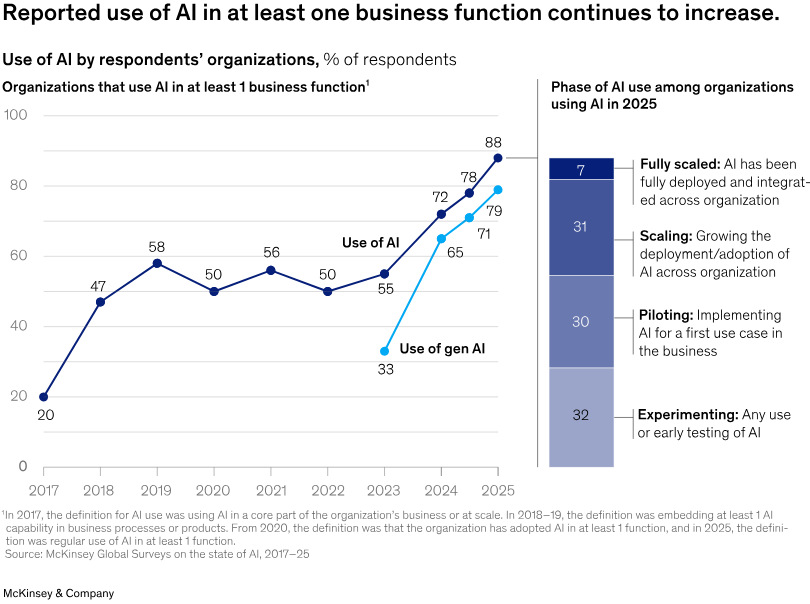
AI is no longer experimental in finance. Around 88% of organizations now use AI in at least one business function, including risk, fraud detection, and operations.
Instead of departments, you get role-specialized systems operating in parallel. A procurement agent evaluates vendors, while a legal agent reviews contract clauses, and a finance agent models margin impact. All referencing the same data state in real time.
No handoffs. No queues.
Cloud platform telemetry already hints at this pattern. Cloudflare and Stripe both report increasing automated API-to-API operational activity where infrastructure, billing, and configuration changes originate from software actors rather than human dashboards.
An AI-operated company, therefore, behaves less like a hierarchy and more like a distributed system.
Managers define policy. Agents execute policy.
The Labor Impact Is Coordination Removal
A common assumption is workforce replacement. Early evidence shows something more specific.
A 2024 Stanford and MIT study on generative AI deployment in knowledge work environments found productivity improvements concentrated in structured, repeatable tasks, particularly documentation and process handling, while complex decision roles remained human-dependent.
That aligns with what AI leaders are seeing internally. Entire categories of work exist to translate information between systems and stakeholders. Status reporting. Data reconciliation. Vendor comparisons. Compliance documentation.
Agents eliminate translation work.
They do not eliminate judgment. They eliminate administrative cognition.
Gartner’s procurement research notes that autonomous sourcing platforms can identify suppliers, compare bids, and perform risk assessment during sourcing events, significantly reducing sourcing cycle times and shifting procurement professionals toward oversight roles rather than coordination.
The enterprise structure compresses. Fewer intermediaries, more domain specialists.
Governance Becomes the Core Engineering Discipline
Here is the part that technical leadership often underestimates.
In a fully agentic enterprise, governance is no longer a compliance function. It becomes the runtime infrastructure.
Early deployments have shown a consistent pattern. Failures rarely originate from model misunderstanding. They originate from unclear organizational rules. When approval policies conflict, agents execute logically consistent but operationally damaging actions.
The system is not hallucinating. It is faithfully executing an ambiguous policy.
Regulatory guidance is beginning to reflect this operational reality. The NIST AI Risk Management Framework update (2024) and EU AI Act implementation guidance emphasize continuous oversight and operational monitoring rather than periodic audit, specifically for automated decision systems.
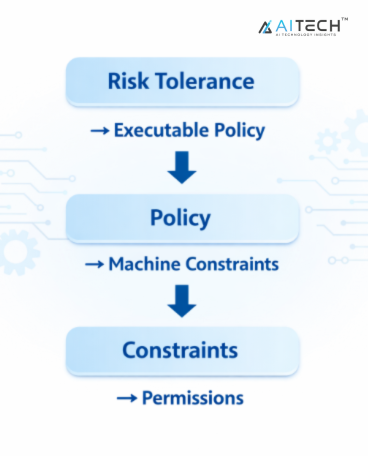
The biggest readiness gap is not model accuracy. It is institutional clarity.
Most enterprises run on undocumented conventions. Autonomous systems cannot.
The Infrastructure Constraint: Compute Economics and Platform Dependence
Technically viable does not mean economically uniform.
Agent workflows require multiple inference steps. A single operational transaction can involve planning, tool selection, verification, and exception handling.
Depending on model tier, pricing disclosures from major providers in 2024–2025 show significant cost differences between lightweight and reasoning-optimized models.
This creates uneven adoption. High-margin digital services automate quickly. Operational industries move more slowly despite larger theoretical gains.
It also introduces a new dependency. An agent-run company depends on external model providers the same way cloud-native companies depend on hyperscalers. Outages, rate limits, or policy restrictions become operational risks.
For the first time, AI platform reliability becomes a board-level business continuity concern.
How the Transition Actually Happens
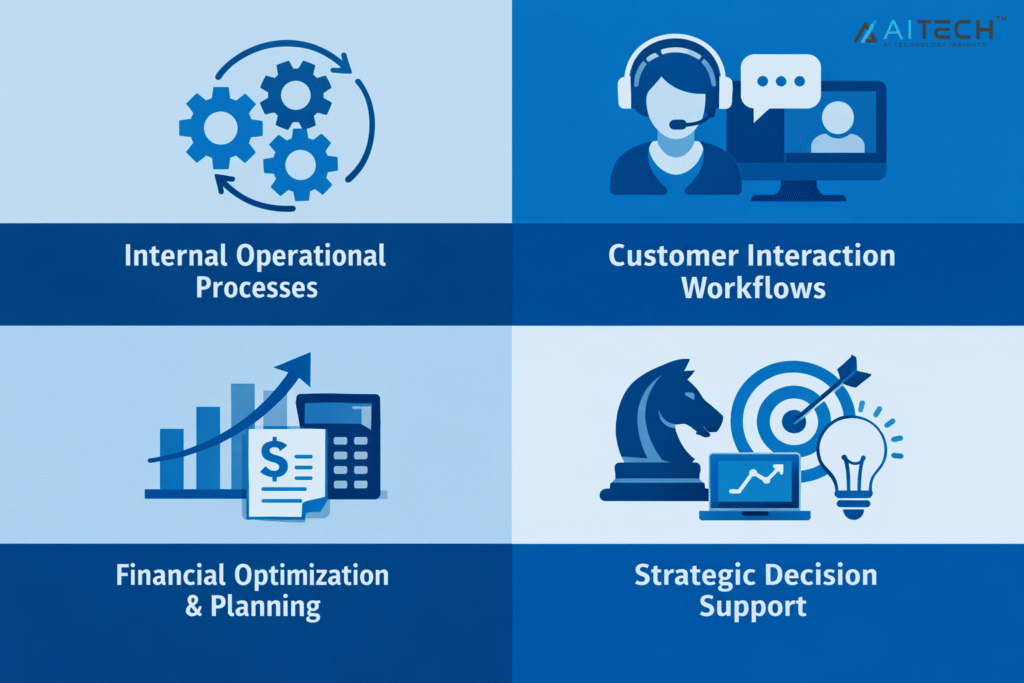
No organization flips to full autonomy. The transition follows a predictable order:
- Internal operational processes.
- Customer interaction workflows.
- Financial optimization and planning.
- Strategic decision support.
We are already in stage one. Many companies now operate internal support routing, compliance checks, and reporting generation through autonomous workflows with human escalation.
The tipping point is economic, not technical. When supervising human execution costs more than supervising automated execution, organizational design changes.
At that point, the company is no longer staffed primarily by employees. It is staffed by systems.
Autonomy Is a Leadership Discipline
An AI-operated enterprise will be extraordinarily efficient. It will also be fragile in a new way.
Human organizations are resilient because humans improvise. Agent organizations are precise because they optimize. If objectives are poorly defined, failure scales instantly.
We already see precursors in automated trading incidents and algorithmic pricing errors. Those were localized systems.
Now imagine the same feedback loop across sales, finance, procurement, and customer operations simultaneously.
The challenge for AI leadership is not deploying models. It is encoding intent.
The companies that succeed will not be the ones with the most advanced models. They will be the ones capable of formally defining how they actually operate.
And most enterprises, even highly technical ones, are discovering they do not yet understand their own processes well enough to automate them safely.
FAQs
1) What is an AI agent enterprise?
An AI agent enterprise is an organization where software agents perform operational tasks across business systems instead of employees manually executing workflows. Agents can interpret requests, call APIs, update records, and coordinate processes such as support routing, procurement checks, reporting, and compliance monitoring with human oversight rather than direct human execution.
2) Which business functions can be automated first by AI agents?
Early adoption typically occurs in structured operational areas: internal IT support, ticket triage, document processing, CRM updates, compliance verification, reporting generation, and vendor comparison. These processes are rules-guided, repeatable, and high-volume, making them easier to supervise than strategic decision-making or customer relationship management.
3) Will AI agents replace knowledge workers in enterprises?
Not entirely. AI agents mainly remove coordination and administrative tasks, not expert judgment. They reduce time spent on documentation, reconciliation, and workflow handling while professionals still handle exceptions, negotiation, risk decisions, and strategic planning. Roles shift toward supervision, policy design, and domain expertise rather than routine execution.
4) What are the biggest risks of a fully autonomous AI-run company?
The primary risk is governance failure, not model intelligence. If business rules or approval policies are unclear, agents may execute actions that are logically correct but operationally harmful. Additional risks include external AI platform outages, rate limits, security permissions misuse, and rapid scaling of small configuration errors across multiple departments.
5) How should executives prepare their organization for AI agents?
Leaders should first document workflows, define approval policies, standardize data access permissions, and implement continuous monitoring. Successful deployments treat governance, auditability, and escalation procedures as core infrastructure. The priority is operational clarity and oversight design, not simply selecting a model vendor or deploying a chatbot.
Discover the future of AI, one insight at a time – stay informed, stay ahead with AI Tech Insights.
To share your insights, please write to us at info@intentamplify.com