If you have watched The Big Short, you’ll know that there’s a moment early on in the movie that quietly pulls you in.
A handful of investors start noticing small cracks in the system. Not headlines or breaking news. Just patterns that don’t behave the way they should.
It’s not one big discovery that changes everything. It’s a series of small signals. Data points that don’t quite add up.
That’s exactly how most high-value signals show up in Customer Relationship Management (CRM) today.
Before diving deeper, here’s the context.
SugarCRM has officially rebranded as SugarAI, positioning its platform as an AI-driven system. Designed to help revenue teams identify risk earlier, prioritize high-value opportunities, and act on next-best actions with greater precision.
CRM’s Shift Toward Continuous AI-Driven Decisioning
The shift reflects a broader movement in enterprise AI. Not toward speculative prediction, but toward anticipating customer behavior, identifying revenue risk, and recommending next-best actions before they become visible in traditional metrics.
This transition signals a deeper architectural evolution in how CRM systems are designed to operate within the enterprise AI stack.
At its core, the model prioritizes continuous inference, probabilistic reasoning, and action orchestration, replacing static data storage and backward-looking reporting with systems built for real-time decisioning.
For practitioners across AI, RevOps, and enterprise data platforms, the concept itself is not new.
What is new is the level of data maturity, model sophistication, and operational integration now required to deliver this at scale.
Explore how AI-driven CRM is reshaping revenue intelligence in your organization.
CRM’s Core Limitation
Data Persistence Without Decision Intelligence
Traditional CRM systems were designed around relational data models, optimized for:
- Transaction logging.
- Pipeline tracking.
- Workflow automation.
These systems operate effectively as systems of record, but they lack native support for:
- High-frequency signal ingestion.
- Temporal pattern recognition.
- Real-time inference pipelines.
- Closed-loop learning.
In AI terms, legacy CRM platforms are state storage systems, not state transition modeling systems.
Salesforce CEO Marc Benioff shared that AI now performs 30–50% of its internal tasks, from customer service to analytics. Their Agent Force platform has reached hundreds of enterprise clients and achieves up to 93% accuracy in customer interactions.
Revenue, however, is driven by transitions:
- A customer reducing order frequency.
- A buying group expanding or contracting.
- A deal stalling due to hidden friction.
- A shift in engagement intensity across channels.
These are inherently time-dependent, multi-variable phenomena. Modeling them requires architectures that go beyond tabular analytics.
What’s Not New
All four capabilities have existed in AI and distributed systems for years:
- High-frequency signal ingestion
Used in domains like algorithmic trading and IoT streaming pipelines for over a decade.
- Temporal pattern recognition
Core to time-series forecasting, fraud detection, and recommendation systems.
- Real-time inference pipelines
Already standard in ad tech, search ranking, and personalization engines.
- Closed-loop learning
Fundamental to reinforcement learning and modern MLOps practices.
What Is New
These capabilities are now being:
1. Embedded directly into CRM systems
Earlier, CRM sat downstream from intelligence systems. Now it’s becoming the execution layer for them.
2. Unified within a single revenue workflow
Instead of fragmented tools. Data platform here, ML model there, CRM elsewhere. These are converging.
3. Operationalized at scale for business users
Not just data scientists. Sales and RevOps teams are now consuming AI outputs in real time.
4. Powered by mature infrastructure
Advances in:
- Streaming architectures like Kafka.
- Feature stores.
- Cloud-native MLOps.
- Transformer-based models.
Assess whether your CRM is capturing data or actually driving decisions
The Emergence of Decision Intelligence in CRM
The rebrand to SugarAI reflects the integration of CRM into what is increasingly described as a decision intelligence layer.
Decision intelligence systems are characterized by:
- Data fusion across heterogeneous sources.
- Predictive and prescriptive modeling.
- Embedded decision logic within workflows.
- Feedback-driven optimization loops.
This aligns with broader frameworks emerging across enterprise AI.
Forrester has identified the rise of revenue intelligence platforms that unify customer-facing functions into a shared analytical and operational layer.
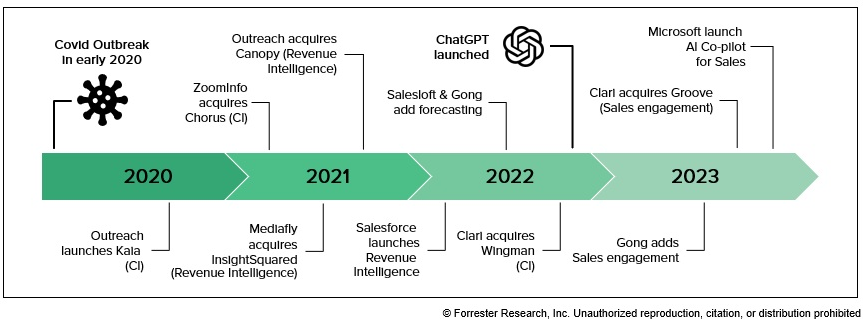
SugarAI is attempting to embed this layer directly into CRM.
Reinventing CRM with Pragmatic AI
For decades, CRM has functioned primarily as a system of record, capturing data, generating reports, and offering backward-looking visibility. But in today’s environment, this is no longer enough.
“CRM must do more than store information; it must help teams take the right action at the right time with proactive, guided execution,” said David Roberts, CEO of SugarAI. “Teams don’t need more data or dashboards, they need direction; SugarAI is about turning signals into action.
“Our customers expect Sugar to solve the 30-year-old promise of CRM – to help sellers and account managers get more value from the software than the effort they put into it,” added Roberts. “Sugar will deliver on this promise with its focus on seller experience and integration to ERP data, all powered by AI.”
The rebrand comes as Sugar continues to be the choice of a growing number of organizations worldwide, such as Mid-America Parts Distributor, Inc, based in Memphis, Tenn.
Since 1952, the company has been a proud distributor of quality aftermarket products for all domestic and import vehicles, along with Original Equipment products for Chrysler, Ford, and General Motors Co. vehicles.
For companies managing large product portfolios and long customer lifecycles, the ability to surface early signals and guide decisions is quickly becoming a competitive necessity.
AI Models That Enable “Precision Selling”
To understand the feasibility of this shift, it is necessary to unpack the types of models and frameworks that underpin such systems.
1. Sequence Models for Behavioral Dynamics
Customer behavior is inherently sequential and requires sequence-aware modeling.
Modern CRM intelligence systems increasingly rely on:
- Transformer architectures.
- Temporal convolutional networks.
- Recurrent neural networks (RNNs, LSTMs)
These models enable the system to detect non-linear temporal dependencies and identify early deviations from expected behavior.
2. Graph-Based Models for Relationship Intelligence
In B2B environments, decisions are rarely made by individuals. They emerge from buying groups, partner ecosystems, and account hierarchies.
Graph neural networks (GNNs) are particularly effective in modeling:
- Relationships between stakeholders.
- Influence patterns within accounts.
- Cross-account similarities.
By representing accounts as nodes and interactions as edges, CRM systems can move beyond isolated records to network-aware intelligence.
3. Predictive and Prescriptive Modeling
Prediction is only the first step.
High-performing systems incorporate:
- Supervised learning models for churn and expansion prediction.
- Anomaly detection models for identifying behavioral outliers.
- Reinforcement learning frameworks for optimizing engagement strategies over time.
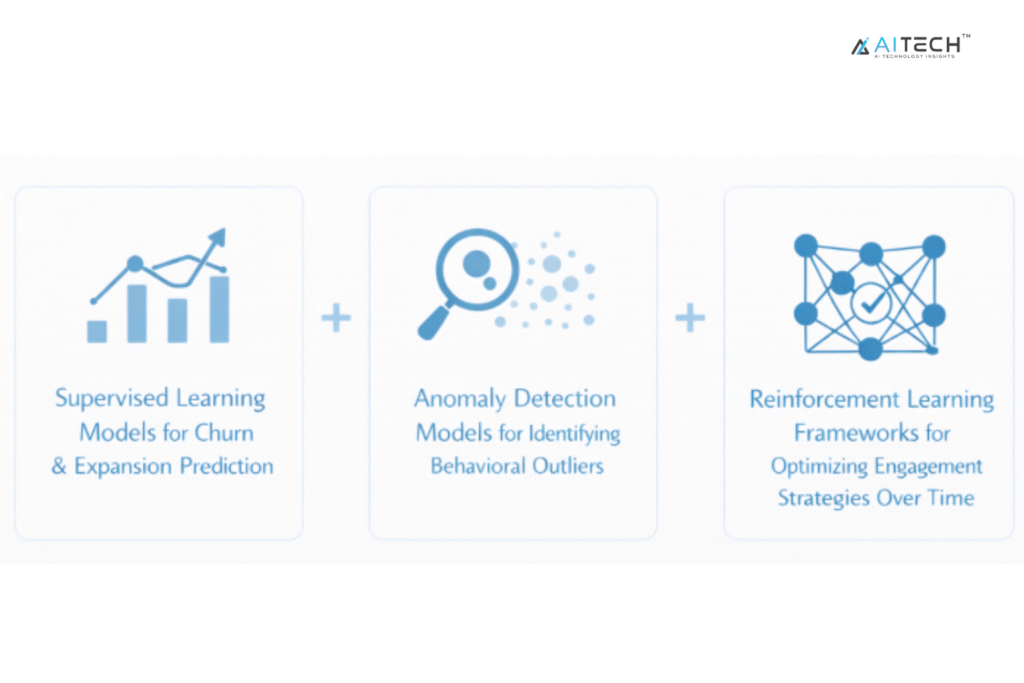
Prescriptive systems then map these outputs to actionable recommendations, effectively solving constrained optimization problems under uncertainty.
4. Retrieval-Augmented Intelligence
A growing trend in enterprise AI is the use of retrieval-augmented generation (RAG) architectures.
In a CRM context, this allows systems to:
- Pull contextual data from CRM, ERP, and external sources.
- Combine structured and unstructured inputs.
- Generate context-aware recommendations or summaries.
This is particularly relevant for sales teams that require explainability alongside recommendations.
Explore which AI models align best with your revenue strategy and data maturity
Data Infrastructure: The Real Bottleneck
While model sophistication is important, the primary constraint in deploying AI-driven CRM systems remains data infrastructure.
To function effectively, platforms like SugarAI must support:
- Feature stores that maintain consistent, real-time representations of customer state.
- Streaming data pipelines for low-latency signal ingestion.
- Data lineage and governance frameworks to ensure model reliability.
- MLOps pipelines for continuous deployment, monitoring, and retraining.
Without these components, even the most advanced models fail to deliver consistent business value.
Market Validation: Why This Shift Is Accelerating
The transition toward AI-driven CRM is not speculative. It is supported by consistent signals across leading research firms.
- Gartner projects that a majority of B2B sales organizations will adopt AI-guided selling by 2026.
- McKinsey & Company estimates 10 to 20 percent revenue uplift from AI-driven sales interventions.
- IDC highlights increasing enterprise investment in AI-powered revenue intelligence platforms.
These findings converge on a single insight.
The value of AI in CRM is not in automation. It is in decision augmentation and prioritization at scale.
Case Context: Where This Approach Delivers Value
The applicability of this model is particularly strong in environments characterized by:
Complex Product Portfolios
Organizations with extensive SKUs and configuration complexity benefit from AI systems that can map purchase patterns to future demand signals.
Long Sales Cycles
In multi-quarter sales processes, early detection of engagement decay or stakeholder disengagement can significantly impact outcomes.
Account-Based Selling Models
AI-driven prioritization ensures that high-value accounts receive timely and contextually relevant interventions.
Companies like Mid-America Parts Distributor Inc. operate in precisely these conditions, where signal interpretation across transactions and relationships is critical.
Industry Convergence: CRM as Part of a Larger AI Stack
The rebranding to SugarAI reflects a broader convergence.
CRM is no longer a standalone system. It is becoming part of an integrated stack that includes:
- Data platforms
- AI/ML pipelines
- Revenue operations systems
Leaders like Marc Benioff have emphasized the shift toward AI-first enterprise applications, where systems anticipate needs rather than react to inputs.
Simultaneously, Forrester has positioned revenue intelligence as a unifying layer across sales, marketing, and customer success.
“The bringing together of ERP and CRM bridges the gap between customer-facing front-office operations and internal back-office business transactions,” said Cameron Marsh, Senior Analyst at Nucleus Research.
“Surfacing trends and correlations across transactional and unstructured data offers key signals that can be extremely valuable for salespersons. For example, identifying when customers have stopped placing orders or when purchasing patterns change. This is a pragmatic approach to AI that supercharges sales and service, and it’s exactly the kind of precision selling the industry needs.”
What Enterprise Leaders Should Evaluate
From a technical and strategic standpoint, organizations evaluating AI-driven CRM platforms should focus on:
- Inference latency: Determines whether insights arrive in time to influence decisions, or after the opportunity has already passed.
- Model explainability: Ensures teams trust and act on AI recommendations, rather than second-guessing them.
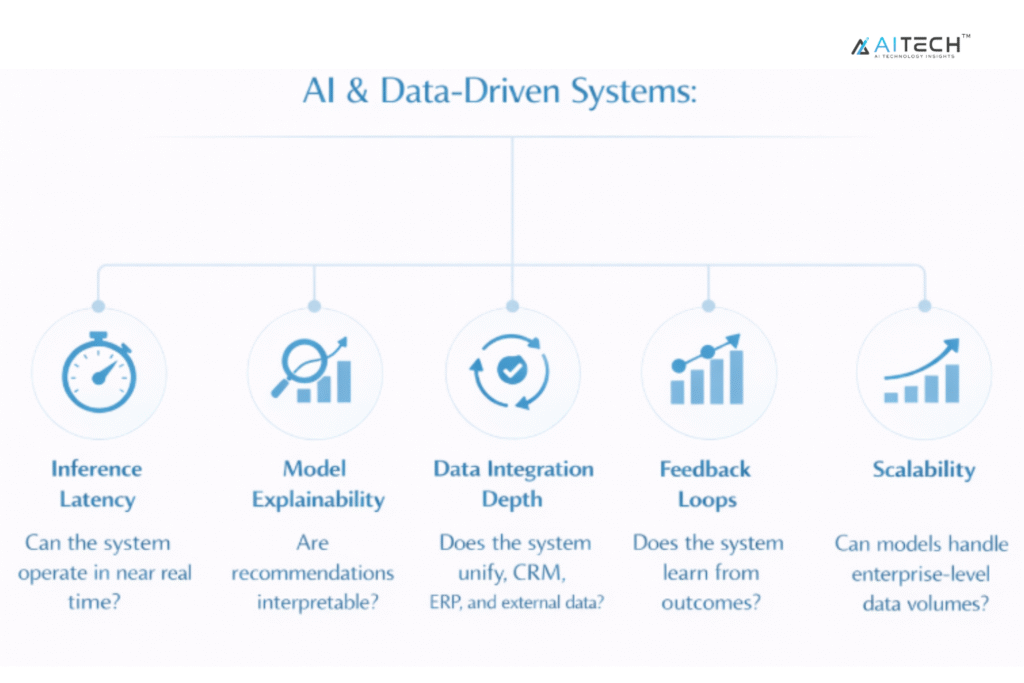
- Data integration depth: Defines how well the system connects fragmented signals into a complete, decision-ready view of the customer.
- Feedback loops: Drives continuous improvement by learning which actions actually lead to better outcomes.
- Scalability: Ensures the system can deliver consistent performance as data complexity and enterprise demands grow.
These factors determine whether a platform can function as a true decision intelligence system.
Benchmark your AI adoption against where the market is heading
CRM Is Becoming an Execution Layer for AI
CRM is evolving into an execution interface for AI-driven decision systems.
The long-term trajectory is clear:
- Data to signals.
- Signals to predictions.
- Predictions to decisions.
- Decisions to autonomous or semi-autonomous execution.
The organizations that succeed in this transition will be those that can:
- Integrate data across systems.
- Deploy and maintain production-grade models.
- Embed intelligence directly into workflows.
If SugarAI can operationalize these capabilities effectively, it will not simply compete in the CRM category.
It will participate in defining the next layer of enterprise AI. One where decision-making itself becomes a scalable, system-driven capability.
From Insight to Impact: Where AI CRM Delivers Real Value
Ultimately, the effectiveness of AI in CRM will not be measured by how advanced the models are, but by how reliably they influence decisions in real time. These capabilities are no longer differentiators. They are becoming baseline expectations.
The real advantage will come from how seamlessly organizations can operationalize them into everyday decision-making across revenue teams. Systems are no longer expected to explain what happened. They are expected to shape what happens next.
FAQs
1. Is AI in CRM actually useful, or just another layer of complexity?
It depends on how it’s implemented. When AI is embedded into workflows and helps teams decide what to do next, it becomes highly valuable. When it just adds dashboards or scores without context, it quickly turns into noise.
2. What does “AI-driven CRM” really mean in practice?
In practical terms, it means the system goes beyond tracking data and starts guiding action. It highlights risks, surfaces opportunities, and recommends next steps based on real-time signals.
3. Why are so many companies still not seeing results from AI in sales?
Most organizations are still using AI in isolated use cases. The real impact comes when AI is connected across systems and integrated into everyday decision-making, not when it sits as a separate feature.
4. How do you know if your CRM is actually intelligent or just automated?
A good test is simple. Does it tell your team what to prioritize and why? If it only records activity or triggers basic workflows, it’s automated. If it helps shape decisions, it’s intelligent.
5. What should leaders focus on before investing in AI-powered CRM?
Focus less on features and more on outcomes. Look for systems that can connect your data, deliver timely insights, and help teams act with confidence, not just analyze more information.
Discover the future of AI, one insight at a time – stay informed, stay ahead with AI Tech Insights.
To share your insights, please write to us at info@intentamplify.com