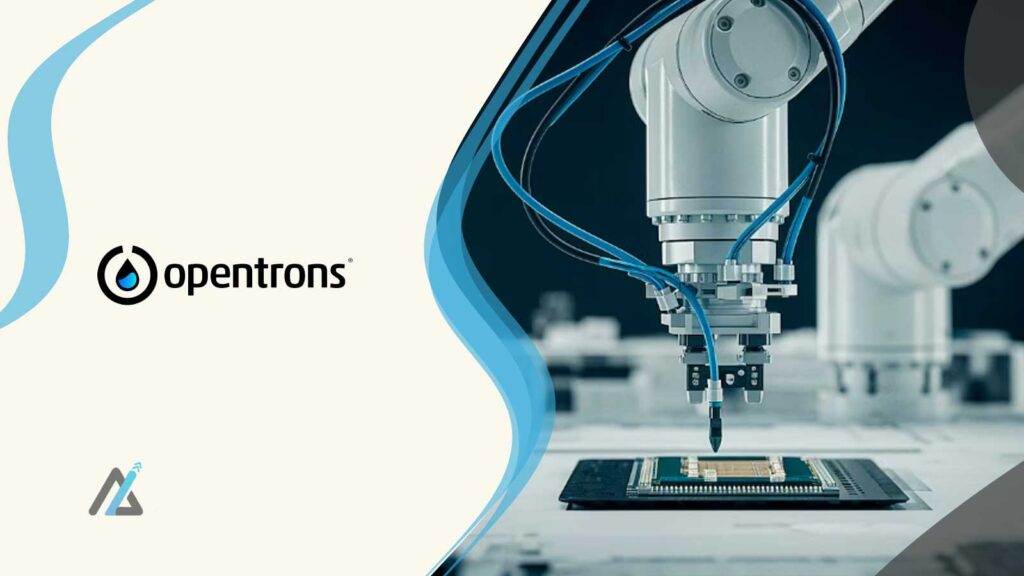
Opentrons Labworks Inc., a leading laboratory robotics company focused on enabling AI-driven autonomous science, is rapidly accelerating the development and deployment of physical AI-powered lab automation in collaboration with NVIDIA. Through this strategic integration, Opentrons is leveraging the NVIDIA Isaac and NVIDIA Cosmos platforms to generate training data specifically designed for physical AI models operating in real laboratory environments.
This partnership marks an important step forward because Opentrons brings a rare combination of real-world scale and scientific expertise. The company has already deployed more than 10,000 robotic systems globally across top research universities and major biopharma organizations. Along with this extensive installed base, Opentrons also contributes deep experimental knowledge gained from both its own robotics platforms and a broad ecosystem of third-party laboratory instruments.
AI Authority Trend: Dassault Systèmes and NVIDIA Partner to Advance Industrial AI
By working closely with NVIDIA, Opentrons is effectively bridging the gap between simulation and reality. As a result, physical AI can transition from theoretical modeling into practical, everyday laboratory workflows. This integration also supports NVIDIA BioNeMo, which provides the foundation for training and deploying AI models aimed at biological discovery. Meanwhile, Opentrons supplies the standardized physical execution layer needed to connect digital scientific design with experimental validation in the lab.
Until now, AI in drug discovery has largely remained limited to prediction-based tasks. For instance, AI systems can propose molecular structures, identify potential drug targets, and analyze massive datasets. However, experimental execution has continued to be the biggest bottleneck in turning these predictions into real discoveries.
Opentrons addresses this challenge by standardizing laboratory execution and producing high-quality training data from real wet-lab operations. Consequently, AI systems can continuously learn directly from experimental results, creating a powerful feedback loop that drives faster innovation.
“We see a future where physical AI unlocks autonomous experimental execution throughout laboratory environments,” said James Atwood, CEO of Opentrons. “AI models and agents propose a hypothesis and experimental plan; our systems execute that experiment. The results are then fed back to the AI in a closed loop to refine the experiment further. When that cycle runs continuously across thousands of labs, discovery timelines compress from years to weeks.”
AI Authority Trend: SharonAI to Deploy 1,000 NVIDIA B200 GPUs at NEXTDC Melbourne Facility
NVIDIA also emphasized the importance of connecting computational intelligence with real-world validation.
“Connecting computational models with experimental validation is essential to accelerating AI-driven drug discovery,” said Stacie Calad-Thomson, North American Business Development Lead for Healthcare and Life Sciences at NVIDIA. “With NVIDIA AI, Opentrons provides the standardized physical infrastructure that turns experimental designs into consistent, reproducible results – helping generate the training data needed to develop physical AI models that can operate across diverse laboratory environments.”
Ultimately, Opentrons continues to expand its role in lab automation by building AI-enabled robotics that streamline workflows from antibody discovery to genomics and proteomics. With systems already deployed across every top-20 U.S. research university and 14 of the top 15 global biopharma companies, Opentrons now operates the world’s largest standardized network of laboratory automation bringing the promise of autonomous science closer to reality.
AI Authority Trend: Argonne, RIKEN, Fujitsu and NVIDIA Partner to Advance AI and HPC for Scientific Discovery
To share your insights, please write to us at info@intentamplify.com