For the past few years, the AI conversation has centered on the latest AI models. However, at the Mobile World Congress- MWC 2026, the industry has signaled a broader shift.
The next phase of artificial intelligence will be defined by the hardware and infrastructure capable of deploying AI at scale across devices, networks, and enterprise environments.
Technology companies have started to introduce a new generation of AI-ready devices, telecom infrastructure, and edge computing platforms.
The latest announcements capture an ongoing industry transition. AI is moving beyond centralized cloud environments toward distributed intelligence embedded across devices, networks, and enterprise systems.
This year’s launches offer a clear snapshot of where AI hardware innovation is heading.
The following product unveilings reveal how vendors are aligning devices, networks, and computing platforms for the next phase of AI deployment.
1. Huawei Atlas 950 SuperPoD
One of the most notable infrastructure launches came from Huawei, which introduced the Atlas 950 SuperPoD AI computing system.
The platform can scale to 8,192 NPUs in a single cluster and is designed for large-scale AI training and high-concurrency inference workloads.
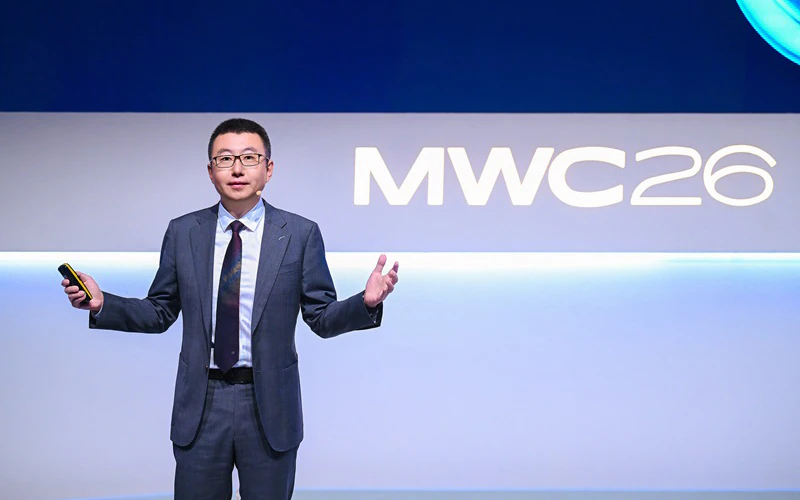
Source: Huawei News
To support AI-native networks, Huawei introduced new Atlas and TaiShan computing platforms designed to power large-scale AI workloads across telecom and data center environments.
Why it matters
It signals Huawei’s push to compete with hyperscale AI data-center platforms dominated by companies such as Nvidia.
2. Huawei TaiShan 950 SuperPoD
Alongside its AI cluster, Huawei unveiled the TaiShan 950 SuperPoD system for high-performance general computing and telecom workloads. The architecture focuses on ultra-low latency and large memory pooling for large distributed workloads.
It is designed to deliver hundred-nanosecond latency and TB-level bandwidth for large-scale computing workloads.
Why it matters
Telecom operators increasingly need hybrid computing platforms that support both AI and traditional network workloads.
3. Honor Robot Phone
As part of its Augmented Human Intelligence strategy, Honor showcased the Robot Phone, a concept device exploring how future AI smartphones could combine sensors, motion systems, and spatial awareness.

Source: Honor News
A smartphone with a 200-MP camera mounted on a small robotic gimbal arm that can track subjects automatically using AI.
Why it matters
The device demonstrates the emergence of embodied AI hardware, where sensors and AI combine with physical motion systems.
4. Honor Magic V6 Foldable
Honor also introduced the Magic V6 foldable smartphone, featuring a silicon-carbon battery, Snapdragon flagship chipset, and high-refresh displays.

Source: Honor News
The foldable device is designed to deliver improved durability, high performance, and AI-enabled productivity.
Why it matters
Foldable hardware continues to evolve alongside AI-driven performance and imaging features.
5. Samsung Galaxy S26 Ultra
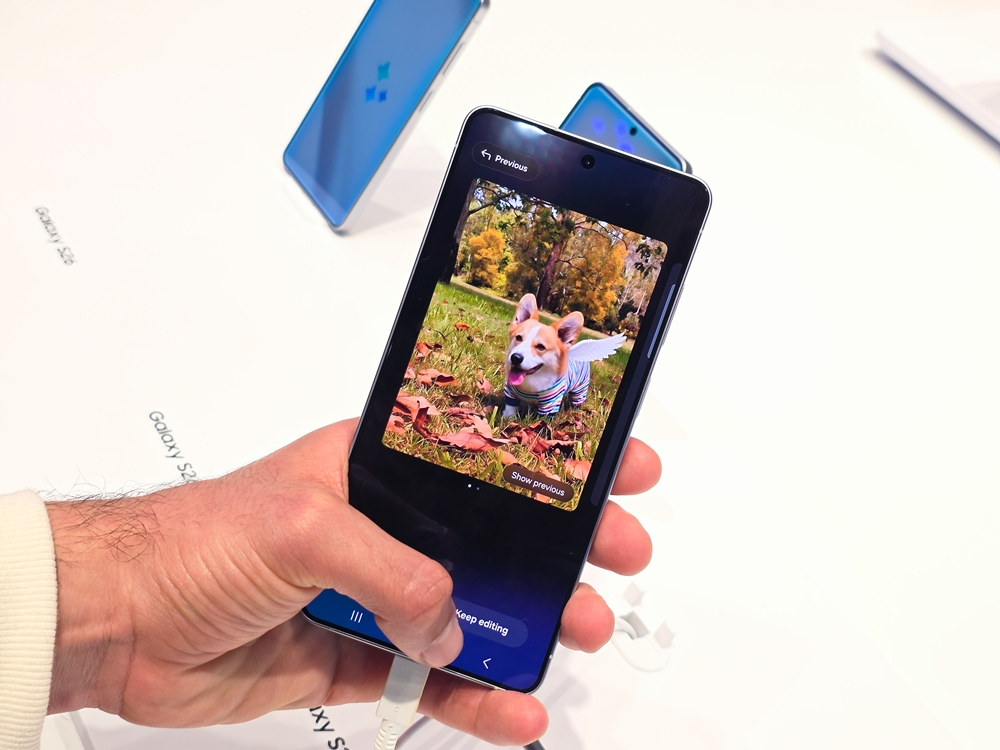
The Samsung Galaxy S26 Ultra drew significant attention at MWC and even won a “Best in Show” award during the event.
Source: Samsung Newsroom
The Galaxy S26 series featured agentic AI capabilities and deeper integration across the Galaxy device ecosystem.
Why it matters
It highlights how flagship smartphones are increasingly designed around AI-enhanced hardware capabilities and ecosystem integration.
6. Lenovo AI Laptops and Concept Devices
Lenovo introduced new AI-focused laptops, tablets, and experimental devices, including foldable gaming handheld concepts and AI-powered productivity devices.
“As AI moves from experimentation to everyday business reality, organizations need technology they can trust, scale, and sustain,” said Eric Yu, Senior Vice President of SMB Segment and Commercial Product Center, Intelligent Devices Group, Lenovo.
Why it matters
PC vendors are positioning AI-enabled personal computers as the next wave of productivity hardware.
7. Tecno Camon 50 Series
Tecno launched the Camon 50 smartphone lineup at the event, emphasizing AI-driven imaging and a broader connected device ecosystem.

Source: PR Newswire
The Tecno Camon 50 Series features a 50MP Sony LYTIA 700C camera system, with Ultra and Pro models supporting AI-powered 60X SuperZoom for enhanced mobile imaging.
Why it matters
Mid-market device manufacturers are aggressively integrating AI features to compete in the global smartphone market.
Strategic Industry Tension: Who Controls the AI Hardware Layer
The announcements at MWC have revealed a growing competitive tension across the technology ecosystem.
Three groups are positioning themselves to control the emerging AI hardware stack–
Device Manufacturers
Companies want to embed proprietary AI assistants and operating systems directly into consumer hardware.
Telecom Operators
Telcos aim to transform their networks into AI infrastructure platforms capable of hosting edge AI services.
Cloud and Semiconductor Companies
Hyperscalers and chipmakers are investing heavily in specialized AI accelerators and edge computing platforms.
This dynamic creates a critical strategic question for enterprises. Where should AI workloads run?
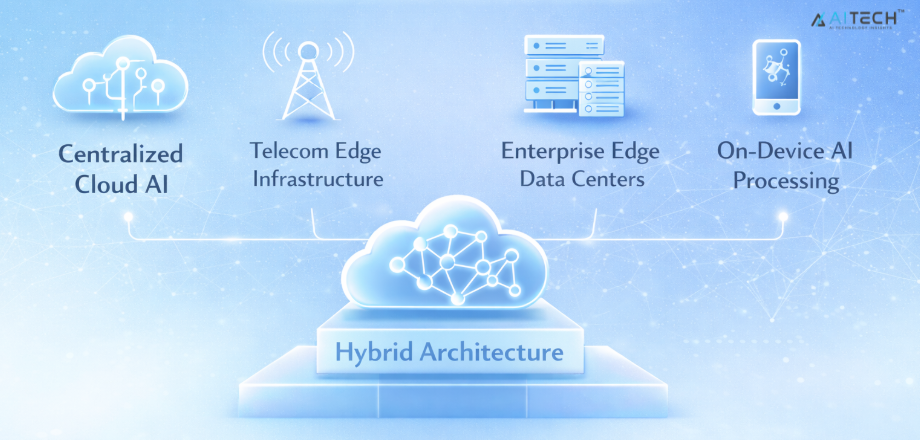
Possible deployment models now include:
- Centralized cloud AI
- Telecom edge infrastructure
- Enterprise edge data centers
- On-device AI processing
In practice, the future will likely be a hybrid architecture spanning all four layers.
What This Means for the AI Industry
The developments at MWC 2026 highlight several practical considerations.
AI Strategy Must Include Infrastructure Planning
Organizations need to evaluate where AI workloads should execute across cloud, edge, and device layers.
Hardware Partnerships Will Become Strategic
Choosing the right device platforms, chip vendors, and telecom partners will directly influence AI performance and scalability.
Edge AI Will Accelerate Industry-Specific Innovation
Industries with real-time operational requirements stand to benefit the most from distributed AI systems.
Enterprises that treat AI purely as a software investment risk missing the infrastructure decisions that will determine long-term competitiveness.
AI Technology Industry Takeaway
MWC 2026 signals a sharp turning point in the evolution of artificial intelligence.
The next phase of AI innovation will not be defined solely by model capabilities. It will be shaped by the hardware ecosystems capable of delivering AI at scale across devices, networks, and edge infrastructure.
AI is moving beyond the cloud. The organizations that design strategies around AI-native hardware architectures and distributed intelligence platforms will be best positioned to capture the next wave of enterprise AI value.
FAQs
1. Why is AI hardware becoming critical for enterprise AI adoption?
AI performance depends heavily on the infrastructure running it. Enterprises now require specialized hardware such as AI accelerators, edge servers, and optimized devices to support real-time processing, scalability, and energy efficiency.
2. What role does edge computing play in enterprise AI deployments?
Edge computing allows AI models to process data closer to where it is generated. This reduces latency, improves response times, and supports real-time applications in industries such as manufacturing, healthcare, and retail.
3. How are telecom networks contributing to AI infrastructure?
Telecom operators are building edge computing environments within their networks. These platforms enable AI services to run closer to users and devices, supporting low-latency applications like smart cities, autonomous systems, and industrial automation.
4. Why are device manufacturers integrating AI directly into hardware?
On-device AI improves speed, privacy, and reliability by allowing certain AI tasks to run locally without constant cloud connectivity. This approach is becoming common in smartphones, PCs, and connected devices.
5. What infrastructure strategy should enterprises consider for future AI deployments?
Most organizations will adopt hybrid AI architectures that combine cloud computing, edge infrastructure, and on-device processing to balance performance, cost, and scalability.
Discover the future of AI, one insight at a time – stay informed, stay ahead with AI Tech Insights.
To share your insights, please write to us at info@intentamplify.com