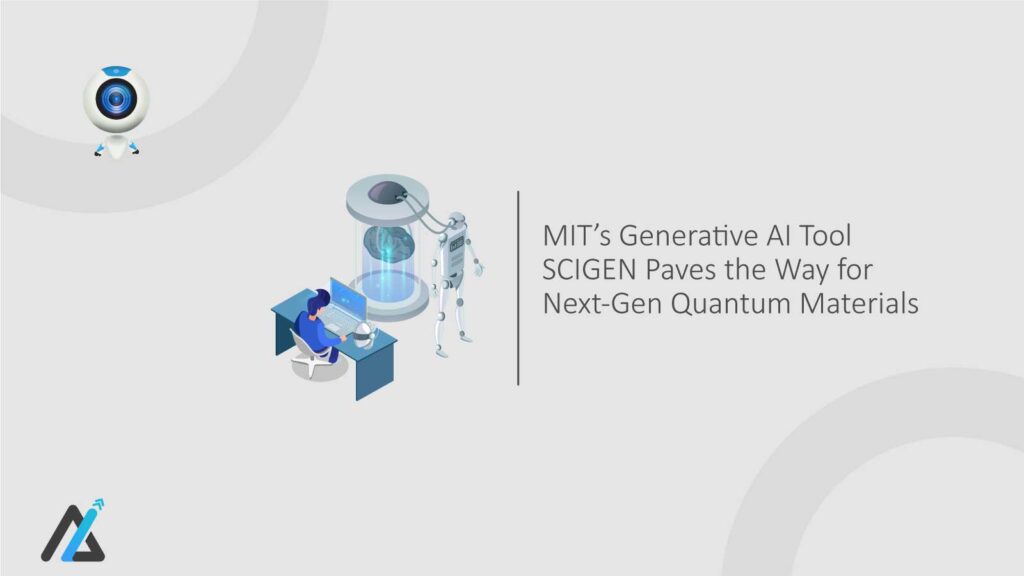
From lab benches to supercomputers, the search for quantum materials has challenged researchers for decades. Every new lattice arrangement, every exotic compound discovered, has the potential to transform computing, electronics, or energy storage, yet progress has traditionally been painstakingly slow. MIT’s Generative AI tool SCIGEN paves the way for next‑gen quantum materials, helping scientists generate promising candidates with geometric precision and quantum-relevant properties.
By bridging advanced AI with deep materials science, SCIGEN is turning what was once a slow, trial-and-error process into a faster, more targeted path toward discovery.
Understanding SCIGEN: The AI Behind the Breakthrough
SCIGEN stands for Structural Constraint Integration in Generative models. Developed at MIT under the leadership of Mingda Li, this framework allows generative AI models to produce materials that conform to specific lattice geometries, such as Kagome, Lieb, or Archimedean patterns.
Traditional AI-generated materials often lacked meaningful quantum behaviors because the models were unconstrained and largely blind to lattice-specific properties. SCIGEN changes this by guiding the AI during each diffusion step, ensuring generated structures adhere to pre-defined geometric constraints. This approach dramatically increases the likelihood that candidate materials will exhibit exotic quantum properties, a crucial factor for applications in quantum computing, spintronics, and advanced electronics.
SCIGEN’s approach demonstrates that constraint-guided AI can turn theoretical possibilities into experimentally viable materials, marking a new era in computational materials science.
Key Features and Results
SCIGEN’s technical achievements are as impressive as its conceptual innovation:
- Massive Candidate Generation: The AI produced over 8 million candidate materials constrained by specific lattices. Approximately 10% passed initial stability filters.
- Density Functional Theory Validation: About 26,000 candidates underwent DFT-based structural relaxation; more than half met optimization criteria.
- Experimental Success: Two compounds, TiPdBi and TiPbSb, were synthesized in the lab, showing magnetic properties consistent with SCIGEN’s predictions.
- Flexible Constraint Application: The tool allows geometric guidance without retraining the underlying generative model, streamlining integration with existing AI workflows.
This combination of AI-driven generation and experimental validation underscores SCIGEN’s potential to accelerate discovery pipelines while reducing costly trial-and-error efforts.
Real-World Implications
SCIGEN’s capabilities have significant implications across industries:
- Quantum Computing: Materials with exotic lattices can improve qubit stability and reduce error rates.
- Electronics and Spintronics: New magnetic compounds may enable next-gen memory devices and high-speed sensors.
- Energy and Sustainability: Exotic materials can optimize thermoelectric devices and energy storage technologies.
- R&D Efficiency: AI-guided candidate filtering reduces laboratory costs and accelerates timelines for material discovery.
For executives and R&D leaders, SCIGEN represents both a technological leap and a strategic opportunity to stay ahead in highly competitive sectors.
Population-Level Applications and Future Material Design
Beyond individual materials, SCIGEN can impact population-level materials discovery:
- By generating synthetic datasets of candidate materials, researchers can model entire classes of compounds before lab synthesis.
- This enables high-throughput screening, allowing teams to prioritize resources toward the most promising quantum materials.
- It also reduces reliance on rare or hard-to-synthesize elements, helping industry meet sustainability goals.
Multimodal AI Integration
A major trend in materials AI is the integration of multiple data types: lattice geometry, chemical composition, and physical properties. SCIGEN’s constraint-guided approach complements multimodal AI, combining structural guidance with predictive modeling of thermodynamic, electronic, and magnetic behavior.
This multimodal capability empowers researchers to:
- Predict material behavior under real-world conditions.
- Optimize multiple performance metrics simultaneously.
- Translate computational predictions into lab-scale synthesis plans efficiently.
Challenges and Considerations
Despite its potential, SCIGEN presents challenges:
- Validation Bottlenecks: Even with DFT pre-screening, not all AI-generated materials are synthesizable.
- Computational Demand: Generating millions of candidates with diffusion-based models requires significant supercomputing resources.
- Integration with Industrial Pipelines: Translating AI output into manufacturable materials is complex and requires close collaboration between computational and experimental teams.
- Ethical & Regulatory Concerns: Intellectual property rights, environmental impact, and compliance with materials safety standards must be addressed from the outset.
Strategic Recommendations for Decision-Makers
Leaders in AI, materials science, and technology innovation can leverage SCIGEN’s promise by:
- Investing in Hybrid AI/Materials Infrastructure: Combine high-performance computing with lab synthesis capabilities.
- Adopting Modular Constraint Frameworks: Start with geometric constraints and progressively integrate functional, chemical, and environmental constraints.
- Fostering Cross-Disciplinary Collaboration: Encourage partnerships between AI researchers, physicists, materials scientists, and engineers.
- Establishing Validation Pipelines: Use iterative feedback loops to improve model predictions and ensure lab viability.
- Aligning Ethics, IP, and Regulatory Compliance: Secure patent rights, ensure safety, and follow evolving AI and materials regulations.
The Road Ahead
Looking forward, SCIGEN-style tools will likely evolve to:
- Incorporate sustainability and functional constraints for greener material design.
- Integrate with quantum simulators for device-level optimization.
- Scale synthesis for industrial applications, from electronics to clean energy.
- Encourage open collaboration, shared datasets, and benchmarking platforms to accelerate discovery across the field.
For U.S.-based companies and global leaders, aligning with these trends provides a strategic advantage in emerging quantum, electronics, and energy sectors.
Leading the Quantum Materials Revolution
MIT’s Generative AI tool SCIGEN paves the way for next-gen quantum materials, but its real value lies in how it is adopted. Leaders, investors, and R&D decision-makers must pair innovation with strategic foresight: developing infrastructure, fostering collaboration, ensuring compliance, and validating AI predictions in the lab.
By understanding and implementing SCIGEN-style approaches, the next wave of quantum materials discovery could be faster, more efficient, and more precise than ever before. This isn’t just a breakthrough in AI or materials science; it’s a blueprint for the future of advanced technology. Those who act decisively today will shape the quantum-enabled world of tomorrow.
FAQs
1. What is MIT’s SCIGEN, and why is it important for quantum materials?
SCIGEN is a generative AI tool that guides models with lattice and geometry constraints to generate quantum materials candidates, speeding up discovery and lab validation.
2. How does SCIGEN accelerate materials discovery for industry leaders?
By generating millions of candidate materials with high-quality lattice structures, SCIGEN reduces trial-and-error, shortens R&D timelines, and lowers synthesis costs.
3. Which industries can benefit most from SCIGEN-generated materials?
Quantum computing, advanced electronics, spintronics, energy storage, and high-performance sensors can leverage SCIGEN’s AI-designed materials for innovation.
4. Are SCIGEN-generated materials experimentally validated?
Yes, select compounds like TiPdBi and TiPbSb have been synthesized in labs and demonstrated the predicted quantum and magnetic properties.
5. What should decision-makers consider before adopting SCIGEN-style AI in R&D?
Focus on infrastructure for computation and synthesis, cross-disciplinary collaboration, validation pipelines, regulatory compliance, and IP management to ensure strategic success.
Discover the future of AI, one insight at a time – stay informed, stay ahead with AI Tech Insights.
To share your insights, please write to us at sudipto@intentamplify.com.