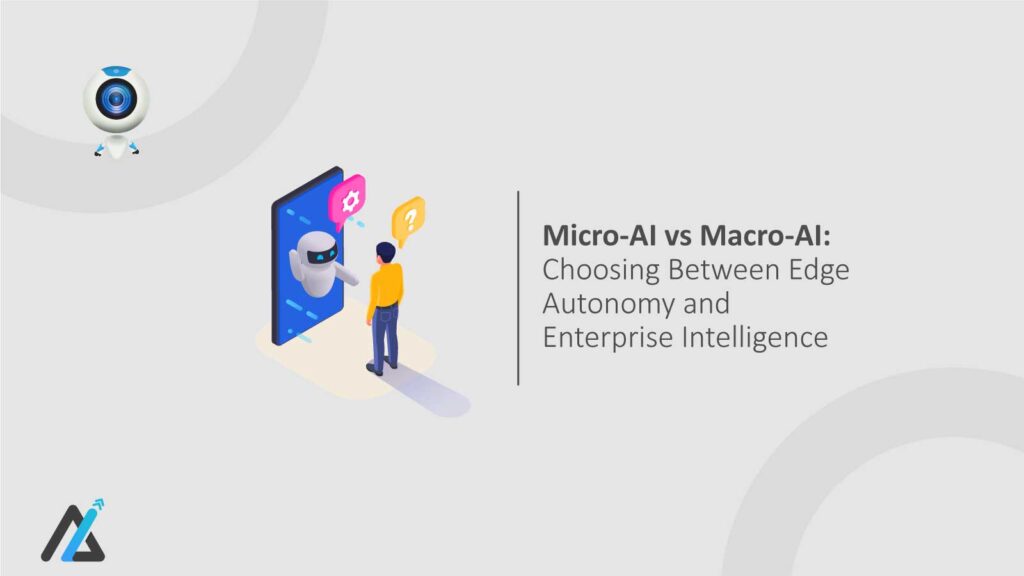
Is your AI strategy designed for instant decisions at the edge, or for sweeping intelligence across the enterprise? That question defines the debate around Micro-AI vs Macro-AI. For technology leaders, the decision isn’t only about systems and infrastructure, it’s about how you want your organization to think, act, and grow.
Micro-AI gives devices the power to respond in real time, without waiting for the cloud. Macro-AI delivers enterprise intelligence that connects the dots across vast amounts of data. Both promise transformative value, but the balance you strike will shape your competitive advantage in an AI-driven economy.
In this article, we’ll break down what sets micro-AI and macro-AI apart, where each excels, and why the smartest path forward may not be choosing one over the other, but blending both for a future that’s fast, intelligent, and resilient.
What Is Micro‑AI?
Micro‑AI refers to AI that runs right where data is generated, on devices like sensors, smart cameras, or IoT nodes. It’s about real‑time responsiveness, ultra‑low latency, and on‑site decision‑making. According to recent market data by Grand View Research, the global Edge AI market, essentially Micro‑AI, was valued at USD 20.78 billion in 2024 and is projected to reach USD 66.47 billion by 2030, with a CAGR of 21.7 %.
In real-world terms, hospitals are deploying edge AI for patient monitoring that requires no constant cloud link. Manufacturers embed QA directly into production lines. Logistics firms use on‑device tracking to boost load efficiency by 10 %.
These examples show how Micro‑AI powers autonomy, devices that think on their own, cutting latency and preserving data privacy.
What Is Macro‑AI?
Macro‑AI, or enterprise intelligence, relates to large-scale AI systems operating centrally. These handle complex models, vast data pipelines, organizational insights, management tools, analytics at scale, and AI‑driven dashboards.
Enterprise AI elevates business operations across customer service, finance, and supply chains. It integrates deeply into workflow systems, demanding security, scale, and integration capability. It’s designed to guide decisions at the macro level across entire enterprises.
When Micro-AI Shines
If speed, privacy, or independence from reliable connectivity matters, Micro-AI shines. Imagine a drone navigating dangerous terrain or a factory sensor stopping downtime before it happens. It’s built for immediate, contextual response.
Real-Time Responsiveness
Micro-AI processes data instantly at the edge, enabling decisions in milliseconds. This is critical for autonomous vehicles, robotic surgery, or safety systems where even small delays could cost lives or revenue.
Data Privacy by Design
By keeping data “on-device,” Micro-AI reduces the risk of breaches or leaks. Healthcare systems, for instance, increasingly rely on edge AI to monitor patients while ensuring sensitive health data doesn’t travel across networks.
Operating in Low-Connectivity Environments
Not every environment has reliable internet or cloud access. From oil rigs to defense applications, Micro-AI allows systems to function without dependency on constant connectivity.
When Macro-AI is More Important
Macro-AI is paramount to gain strategic, cross-organization insights. When forecasting sales, modeling risk, or optimizing supply chains, central AI provides breadth to insights that are derived from scale rather than proximity.
Big-Picture Decision Making
Macro-AI processes millions of data points across the enterprise. This data will help chief executives see long-term trends, allocate resources, and formulate long-term strategies during an executive meeting involving high-profile customers.
Consistency Across the Enterprise
Centralized AI systems ensure decisions are similar across business units. A multinational bank, for example, should make its regional fraud detection policy consistent so that compliance and efficiency are much easier to achieve.
Scalable, Integrated Solutions
Macro-AI systems are easily integrated into existing enterprise software, systems, CRM applications, and ERP tools. They are well-suited for organizations managing thousands of processes in parallel.
A Smart Hybrid Strategy
You don’t have to choose one side. The real magic lies in combining Micro-AI’s edge autonomy with Macro-AI’s enterprise-level insight. For example, edge devices can gather and act on data locally, then selectively sync summaries to a central AI that models trend shifts across sites. This hybrid model gives businesses both speed and scale, autonomy and oversight.
Edge-to-Enterprise Collaboration
Edge devices act as first responders, handling immediate decisions. Later, they share anonymized or aggregated insights with Macro-AI platforms for enterprise-wide optimization.
Cost and Efficiency Balance
Running everything on the cloud can get expensive, while edge-only systems can be siloed. A hybrid strategy balances costs by pushing urgent tasks to the edge and strategic processing to the enterprise level.
Real-World Hybrid Example
In retail, smart cameras use Micro-AI to detect shelf gaps and restock alerts instantly. These insights then feed into Macro-AI platforms that predict overall demand patterns across hundreds of stores.
Agentic AI and edge general intelligence show this trend toward decentralized, collaborative, adaptive AI agents at the edge that still tie into enterprise-level coordination.
From Micro Processes to Macro Intelligence: A Unified Approach
The conversation around Micro-AI vs Macro-AI is not about rivalry, but about alignment. Micro-AI empowers devices with autonomy, enabling split-second decisions in the field. Macro-AI, on the other hand, equips enterprises with intelligence at scale, providing the clarity leaders need to steer long-term strategy.
Forward-looking organizations will avoid thinking of these approaches as an “either-or” choice. The true value emerges when edge autonomy and enterprise intelligence converge, creating a system that is both agile and deeply informed. Imagine an ecosystem where every sensor, device, and dashboard contributes to a continuous feedback loop: fast, secure, and strategically aligned.
Research by Tredence suggests that this hybrid future is already taking shape. From healthcare to manufacturing to logistics, AI strategies are shifting toward models where local autonomy meets enterprise-wide intelligence. For decision-makers, the call to action is clear: define not just where AI fits today, but how Micro-AI and Macro-AI can evolve together to future-proof your organization.
So, ask yourself: Is your AI vision narrow and siloed, or is it positioned to integrate speed with strategy? The answer will determine whether your enterprise simply adapts or leads in the age of intelligent autonomy.
FAQs
1. How do I know when to use Micro‑AI versus Macro‑AI?
If your priority is instant response and local decision-making, such as safety alerts or device autonomy, Micro‑AI is ideal. But for strategic insights across departments, Macro‑AI’s broader view serves better. Many organizations find value in combining them.
2. Does Micro‑AI mean more security?
Yes. Keeping data processing locally reduces exposure risks. Sensitive data remains on-device, minimizing transmission vulnerabilities. That said, secure edge designs are still essential.
3. Can an enterprise have both Micro‑AI and Macro‑AI work together?
After processing data and acting independently, edge devices can provide a Macro-AI platform with crucial or summary insights. Both speed and strategic depth are provided by this hybrid.
4. What sectors benefit most from Micro‑AI?
Sectors needing instant, localized decisions, healthcare monitoring, industrial automation, logistics tracking, and autonomous systems gain the most from edge autonomy.
5. Is implementing Micro‑AI expensive?
Initial costs may include specialized hardware and integration. But savings from lower cloud usage, reduced latency, and enhanced autonomy often justify the investment.
Discover the future of AI, one insight at a time – stay informed, stay ahead with AI Tech Insights.
To share your insights, please write to us at sudipto@intentamplify.com