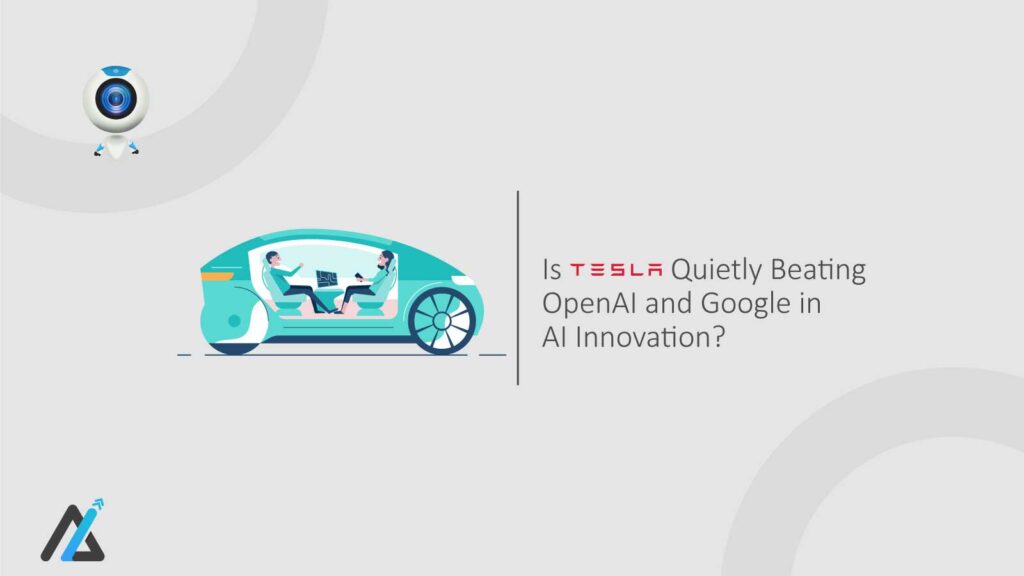
The majority of Artificial Intelligence discussions usually involve mostly the same names. OpenAI unveils a new model. Google declares a breakthrough. The tech world sends its reactions. In the meantime, Tesla is still quietly building up their power. No flashy demos. No viral chatbot launches. Just AI systems learning from the real world, every day. This implies a serious and timely question: Is Tesla quietly outperforming OpenAI and Google in practical AI innovation? The reply hinges on how we view the development of artificial intelligence.
AI Innovation Is More Than Generating Text
Most people interact with AI through their screens.
You write a prompt. They give you an answer. The interaction stops.
Such an AI is still worth a lot. It is a great tool that can be used to make work more efficient and research faster.
McKinsey notes that generative AI could add up to $4.4 trillion annually to the global economy, largely through productivity gains.
On the other hand, Tesla’s AI is not like that.
Decision-making systems, which can work in the real world, are what Tesla is building. Their AI has to be able to see, predict, and, on most occasions, decide within a few seconds.
One language model can be used to explain traffic rules. Tesla’s AI is the one that drives the car.
Tesla Trains AI Using the Real World
Tesla creates AI decision-making systems that can work in the real world. Its AI is required to see, predict, and do- usually within a few seconds. According to Tesla’s Impact Report and AI Day disclosures, the fleet generates billions of real-world video frames every day, feeding continuous learning loops for its neural networks.
One language model can be used to teach the traffic rules. Tesla’s AI is the one that actually follows the traffic.
That difference matters.
- Tesla’s AI learns from over five million vehicles worldwide, each vehicle being a data sensor in a mobile unit.
- Every mile Tesla drives updates the company’s neural networks with ground-truth scenarios.
- Vehicles, according to Tesla, are producing billions of video frames every day.
- Training is predominantly done through the use of vision-based neural networks.
- Tesla has made the full transition to a camera-only system, getting rid of radar and lidar.
This approach is similar to how humans learn. First, we notice. Then, we change accordingly.
OpenAI and Google predominantly depend on carefully chosen digital data.
Tesla depends on the real world.
Dojo Strengthens Tesla’s AI Independence
Tesla’s AI in-house supercomputer, Dojo, is a manifestation of a deep strategic move. In a move to not put all eggs in one basket, i.e., not depend on cloud providers solely, Tesla crafted the hardware that is most suitable for the training of video-based neural networks.
In confirmation of the same, Tesla stated that Dojo offers a compute power of exaFLOP level, which makes it one of the top publicly known AI training systems.
For context, NVIDIA notes that exaFLOP-scale compute is essential for training next-generation autonomous systems.
These changes bring Tesla:
- Faster training cycles
- Lower infrastructure dependency
- Complete control over the AI stack from beginning to end
This extent of integration is still very limited in the AI field.
OpenAI and Google Lead in General Intelligence
OpenAI and Google dominate general intelligence, especially in:
- Large language models
- Multimodal reasoning
- Knowledge synthesis
- Creative generation
According to Gartner, over 80% of enterprises will use generative AI APIs or models by 2026, led by platforms from OpenAI and Google.
Their tools are made to facilitate professionals in writing, coding, analyzing, and researching at a faster pace.
Tesla is not a direct competitor in those fields.
Rather, Tesla concentrates on autonomous intelligence ones that need to make the right decision in unforeseen surroundings.
Driving relies on:
- Visual perception
- Context awareness
- Human behavior prediction
- Real-time judgment
Tesla’s Full Self-Driving software is capable of handling multiple neural networks at the same time, each one dealing with perception, planning, and control.
This is one of the most difficult AI problems in existence.
Tesla’s Quiet Advantage
Tesla’s AI strategy gives the company three structural advantages:
- Continuous learning: The program gets better with every mile driven.
- Hardware–software alignment: The evolution of the chips, models, and training systems is coordinated.
- Monetization by design: AI features directly increase the value of the product.
That generates a self-sustaining loop that improves through AI, and the product funds better AI.
Not many companies are able to carry out this cycle on a large scale.
Summary
Tesla is not attempting to be better than OpenAI or Google in terms of language capabilities. Tesla is solving a different AI problem.
While OpenAI and Google are extending the limits of knowledge-based intelligence, Tesla is moving the frontier of autonomous intelligence in motion.
The work is done quietly.
It hardly ever gets attention online.
Yet, it changes what AI is capable of doing in the real world.
Sometimes the most advanced AI doesn’t talk.
It drives.
FAQs
1. Is Tesla an AI company or an automaker?
Tesla is both and is using its vehicles as platforms for large-scale AI systems.
2. What makes Tesla’s AI different from OpenAI’s?
While OpenAI focuses on language generation, Tesla concentrates on perception and action in the physical world.
3. Are Tesla using large language models?
Language models have a very limited role compared to vision-based neural networks, which are used in Tesla.
4. Why should AI be fed with real-world data?
Real-world data serves as a foundation for continuous learning and adaptation in unpredictable conditions.
5. Is Tesla’s AI scalable?
Tesla’s model of integrating data, hardware, and software is a great long-term, scalable solution.
Discover the future of AI, one insight at a time – stay informed, stay ahead with AI Tech Insights.
To share your insights, please write to us at info@intentamplify.com