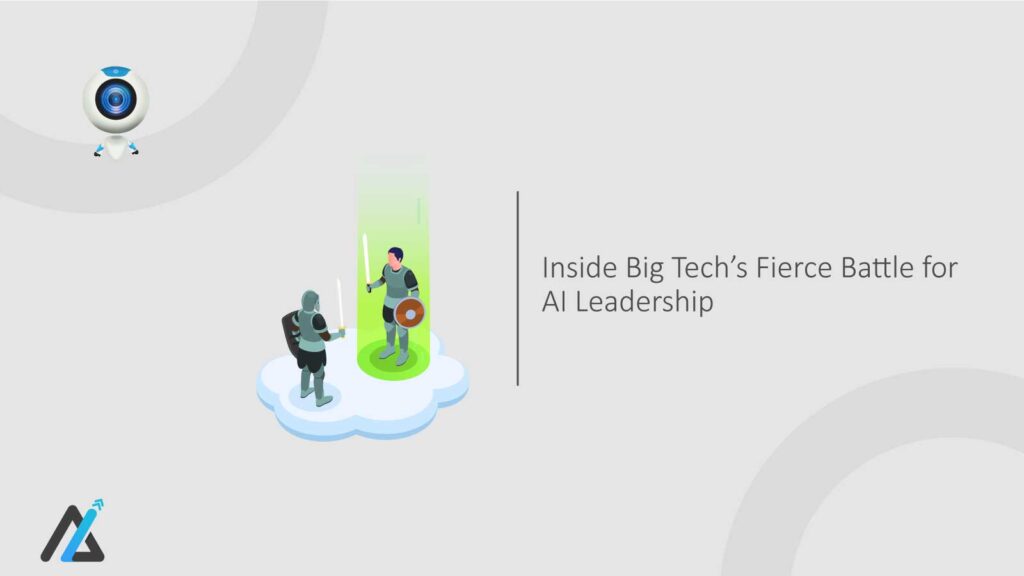
The race to dominate artificial intelligence is no longer a quiet tech pursuit; it’s a high-stakes competition that influences industries, economies, and global innovation. From Microsoft’s deep integration with OpenAI to Google and Meta’s large-scale AI models, big tech AI leadership is shaping the tools and standards that will define the future.
At a recent San Francisco dinner, OpenAI CEO Sam Altman issued a timely reality check on AI enthusiasm, saying: “Are we in a phase where investors as a whole are overexcited about AI? My opinion is yes.” He added, “When bubbles happen, smart people get overexcited about a kernel of truth,” drawing a clear parallel to past tech bubbles.
For business leaders, healthcare innovators, and tech enthusiasts alike, understanding this rivalry is more than curiosity; it’s essential. Who will control AI platforms, and how will these choices affect enterprises, society, and the global economy? In this article, we explore the forces, strategies, and innovations driving the fierce contest for AI supremacy.
What’s Driving the AI Leadership Race
While market share and bold product launches dominate news cycles, the real story lies in the forces shaping Big Tech’s path forward. From investor sentiment to talent wars and chip dominance, these undercurrents reveal what it truly takes to secure AI leadership.
1. Investor Sentiment and the “AI Bubble” Debate
OpenAI CEO Sam Altman recently cautioned that investor enthusiasm may be inflating an AI bubble. While venture capital continues pouring billions into AI startups, history reminds us that exuberance often overshadows reality.
2. The Race for Talent: AI’s Most Scarce Resource
Behind billion-dollar data centers lies the competition for AI researchers and engineers. Google, OpenAI, and Anthropic are offering unprecedented salaries and stock options. Some experts compare this to the space race, where the brightest minds shifted entire industries.
3. Hardware Wars: Why Chips Are the New Oil
Big Tech isn’t just fighting on software. Nvidia, AMD, and even custom chips by Google (TPUs) and Amazon (Inferentia) drive the AI boom.
4. The Ethics Arms Race
AI leadership isn’t just about speed but also responsibility. Each company now positions itself as the most ethical innovator.
5. Beyond Hype: Where AI Delivers Real Value
Balance the narrative by showing practical wins amid the hype:
- AI in healthcare for early cancer detection.
- AI copilots in enterprise software are saving thousands of work hours.
- Consumer-facing wins like translation, accessibility, and personal assistants.
The Multi-Billion-Dollar Stakes
The AI arms race is no small affair. Companies are investing billions in research, cloud infrastructure, and next-generation models.
- Nvidia is supplying the chips that power generative AI platforms.
- Microsoft is expanding OpenAI’s technology into enterprise and cloud offerings.
- Google DeepMind continues to refine multi-modal intelligence for real-world applications.
- Meta is developing proprietary AI systems designed to integrate with social and enterprise software.
Such investments highlight the stakes of big tech AI leadership: beyond revenue, it’s about defining the future of AI adoption, setting industry standards, and controlling ecosystems.
Rivalries and Strategic Maneuvers
Competition extends beyond financial investment. Public positioning, product launches, and acquisitions signal an aggressive pursuit of dominance.
Meta has poured resources into large-scale foundation models, while Google DeepMind focuses on advanced multi-modal AI research. Microsoft continues integrating ChatGPT into everyday tools, demonstrating the market potential of AI in productivity. OpenAI, meanwhile, is experimenting with AI across sectors, from healthcare to enterprise automation.
These rivalries are dynamic, pushing innovation forward at unprecedented speed. They also influence public perception, policy discussions, and even investor confidence.
Impact Across Industries
The race for big tech AI leadership is reshaping multiple sectors:
Healthcare
AI models now assist in early diagnostics, patient management, and predictive analytics. For instance, ChatGPT-5 and other AI-driven tools are enhancing clinical decision support, improving outcomes, and reducing costs.
Finance
Predictive AI models streamline risk assessment, fraud detection, and portfolio management. The companies that lead AI innovation shape the tools banks and insurers adopt.
Enterprise Operations
AI-driven automation optimizes workflows, reduces human error, and enhances decision-making. From CRM platforms to supply chain logistics, AI leaders influence the enterprise software landscape.
Risks and Ethical Considerations
While the potential benefits are substantial, there are considerations that leaders must evaluate carefully:
- Concentration of power: Few companies may dominate AI development, potentially shaping markets and access.
- Ethical questions: Bias, transparency, and privacy remain essential concerns.
- Investor dynamics: Some analysts warn of overexcitement and inflated valuations in AI sectors.
Addressing these concerns is critical to ensuring that AI benefits society as broadly as possible while maintaining trust in technological progress.
The Human Angle
Beyond strategy and finance, this battle is about people, engineers, researchers, clinicians, and end-users. Consider a healthcare provider using AI to predict patient outcomes: the system’s precision can improve lives and inform better decisions. For the everyday user, AI integrated into apps, assistants, and productivity tools is increasingly part of daily routines.
Humanizing AI adoption requires transparency, education, and empathy. Companies that succeed in big tech AI leadership must not only build powerful models but also consider accessibility, fairness, and usability.
Looking Ahead
The next decade will be shaped by who leads in AI research, model deployment, and ecosystem integration. Collaboration, regulation, and global competition will dictate which companies set the standards.
For decision-makers, staying informed is crucial. Understanding the strategic maneuvers, technological investments, and regulatory shifts allows organizations to anticipate trends and opportunities effectively.
Big tech AI leadership is a signal of where innovation, markets, and societal transformation converge.
Understanding the High Stakes Race for AI Leadership
The competition for AI supremacy among big tech companies is fierce, multi-dimensional, and consequential. With billions invested, advanced models developed, and ecosystem influence at stake, the battle for AI leadership is defining the next technological era.
For professionals across sectors, understanding these dynamics provides insight into innovation trajectories, investment opportunities, and the potential societal impact of AI. The future of AI is not only technological, it is strategic, ethical, and human-centered.
FAQs
1. What does Big Tech AI leadership mean?
It refers to companies driving AI innovation, setting standards, and influencing adoption across industries.
2. Which companies are currently leading AI innovation?
Microsoft, Google, Meta, Amazon, and OpenAI are at the forefront of AI development and ecosystem expansion.
3. How does AI leadership affect industries?
It shapes adoption speed, ethical standards, access to AI tools, and the overall direction of sector innovation.
4. Are there risks associated with Big Tech AI dominance?
Yes. Concentration of power, potential bias, privacy concerns, and market hype are key considerations.
5. How can professionals stay informed on AI trends?
Tracking corporate announcements, industry reports, regulatory developments, and technological research helps anticipate market shifts.
Discover the future of AI, one insight at a time – stay informed, stay ahead with AI Tech Insights.
To share your insights, please write to us at sudipto@intentamplify.com.