
The latest announcement about the NTT DATA–NVIDIA alliance introduces a new step in how enterprises may approach artificial intelligence at scale.
The two companies have unveiled NVIDIA-powered enterprise AI factories, an initiative designed to help organizations build, deploy, and manage AI systems within secure and production-ready environments.
While the announcement focuses on infrastructure and implementation capabilities, it also reflects a broader shift taking place across enterprise technology.
As AI adoption accelerates, organizations are moving beyond experimentation toward operational models that can support large-scale AI deployment across workflows, data systems, and decision processes.
This analysis examines what the partnership signals for the evolving enterprise AI ecosystem. It explores the technology foundations behind the AI factory concept, the operational challenges enterprises are trying to solve, and the potential impact such models could have on how organizations design and scale AI-driven systems.
From AI Pilots to Enterprise Infrastructure
The past few years have produced no shortage of AI innovation inside large organizations. Pilot projects appear across departments. Small teams experiment with generative models, automation tools, and predictive analytics. Some succeed. Most stall.
The issue is rarely the model itself.
Enterprise environments are complex systems built over decades. Data is fragmented across platforms, compliance requirements vary across regions, and production systems must operate with reliability that experimental AI environments rarely demand.
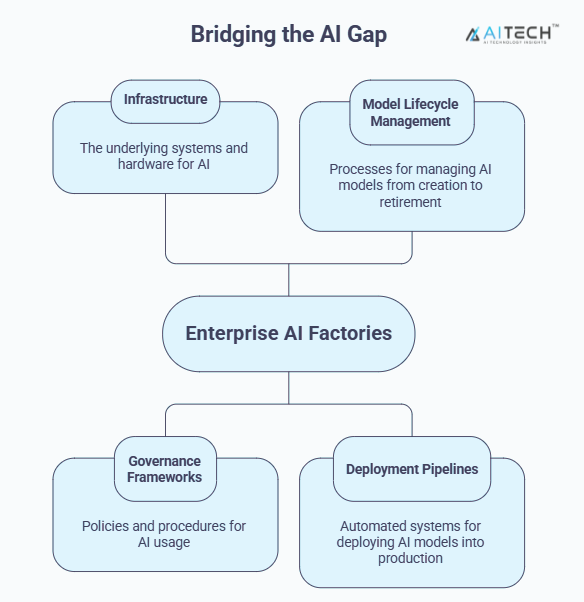
What companies increasingly need is not another AI tool, but a foundation capable of supporting AI as an operational layer. Infrastructure, governance frameworks, model lifecycle management, and deployment pipelines. All working together.
This is the gap initiatives like enterprise AI factories attempt to close.
Why the AI Factory Model Is Emerging Now
The concept of an AI factory reflects an effort to industrialize AI development and deployment. Instead of building models in isolated environments, organizations create standardized AI production systems where data pipelines, training environments, deployment infrastructure, and monitoring frameworks operate continuously.
This shift is happening as AI adoption accelerates across industries.
According to McKinsey’s State of AI research, around 65% of organizations now report using generative AI in at least one business function, a sharp increase from the previous year.
As adoption grows, the challenge becomes operational. Running a handful of AI experiments is manageable. Running hundreds of models across departments requires something closer to an industrial production system.
The AI factory model attempts to provide exactly that.
NVIDIA’s Expanding Role in the Enterprise AI Stack
The partnership also reflects a broader transformation in NVIDIA’s position within the AI ecosystem.
For years, the company’s role was largely defined by its dominance in GPU hardware. That dynamic has changed. NVIDIA is increasingly building an integrated AI platform that includes networking architecture, model development frameworks, orchestration software, and inference services.
Within the NTT DATA initiative, these capabilities combine to form the technical backbone of the AI factory architecture. The result is a stack designed not just for training models, but for managing the full lifecycle of enterprise AI systems.
“Visionary enterprises are redesigning core workflows end to end with AI, and they need trusted partners working in unison to achieve transformative and measurable results,” said Abhijit Dubey, CEO at NTT DATA, Inc.
This expansion signals an important shift. The future of enterprise AI may depend less on who builds the most advanced models and more on who controls the infrastructure environment where those models operate.
The Operational Gap Slowing Enterprise AI
Despite rapid innovation in AI technology, many organizations still struggle to translate experimentation into measurable outcomes.
Research from MIT suggests that a large majority of enterprise generative AI initiatives have yet to produce measurable profit impact, largely because companies face difficulties integrating AI systems into operational workflows.
This problem is rarely visible in technology demonstrations. AI models often perform impressively in controlled environments. The difficulty emerges when those systems must operate inside real business processes.
AI factories are designed to address this operational friction by providing standardized environments where AI systems can be deployed, monitored, and governed consistently.
Whether that approach proves effective remains an open question.
Where Enterprise AI Factories May Deliver Early Value
The industries most likely to benefit from standardized AI infrastructure share several characteristics. They manage large volumes of structured data, operate complex workflows, and already rely on advanced computing environments.
Healthcare organizations, for example, are exploring AI for imaging analysis, diagnostics support, and clinical workflow automation.
Manufacturing firms are experimenting with digital simulations and predictive maintenance models. Financial institutions continue to expand AI use in risk modeling and fraud detection.
In each of these sectors, the challenge is not identifying AI use cases. It is operationalizing them reliably at scale.
Infrastructure models such as AI factories may offer a pathway toward that goal by providing shared environments where multiple AI applications can be developed and deployed consistently.
The ROI Question That Still Hangs Over Enterprise AI
Enterprise investment in AI continues to grow rapidly, but measuring business impact remains difficult.
Many organizations still lack clear frameworks for measuring how AI systems affect productivity, decision making, or revenue generation.
As a result, the next phase of enterprise AI adoption will likely focus less on technological capability and more on operational outcomes.
In that context, initiatives like the NTT DATA and NVIDIA AI factory model represent an attempt to bridge a persistent gap in enterprise technology strategy.
FAQs
1. What is an enterprise AI factory and why are companies adopting it?
An enterprise AI factory is a standardized infrastructure environment where organizations can build, train, deploy, and manage AI models at scale. Companies are adopting this approach to move beyond isolated AI pilots and create repeatable systems.
2. How does AI infrastructure affect enterprise AI adoption?
AI infrastructure determines whether organizations can scale AI beyond experimentation. Without reliable compute resources, integrated data pipelines, and deployment frameworks, many AI initiatives remain confined to pilot programs.
3. Why are partnerships between AI infrastructure providers and systems integrators increasing?
Enterprise AI deployments often require both advanced computing platforms and deep implementation expertise. Partnerships between infrastructure providers and systems integrators help organizations bridge the gap between AI technology and real-world enterprise environments.
4. Which industries are expected to benefit most from enterprise AI infrastructure models?
Industries that generate large volumes of operational data are expected to see early benefits. Healthcare, financial services, manufacturing, and telecommunications organizations are already investing heavily in AI infrastructure to support automation, predictive analytics, and decision intelligence systems.
5. What challenges still prevent enterprises from realizing ROI from AI investments?
Many organizations struggle to integrate AI systems into existing workflows, data environments, and governance frameworks. Without proper infrastructure and operational alignment, AI initiatives often fail to move beyond experimentation, limiting their ability to deliver measurable business outcomes.
Discover the future of AI, one insight at a time – stay informed, stay ahead with AI Tech Insights.
To share your insights, please write to us at info@intentamplify.com