The debate over artificial intelligence has largely revolved around innovation, regulation, and safety. Until the United States Department of Defense labeled one of America’s leading AI startups a “supply chain risk”.
The decision effectively blocked the use of Anthropic’s Claude models in Pentagon contracts and forced defense contractors to phase out the technology.
This confrontation has exposed a deeper question that Silicon Valley has mostly avoided so far. Who ultimately controls frontier AI once it becomes strategically important?
Recent analysis in AI Technology Insights examining what Anthropic’s reported $10 billion funding push signals for AI investment highlighted how the company has become one of the most strategically important players in the global AI ecosystem.
The scale of capital flowing into frontier model developers reflects a broader shift. Artificial intelligence is no longer just a commercial technology race. It is increasingly treated as national infrastructure.
Why the Pentagon Views AI as Military Infrastructure
From the Pentagon’s perspective, the argument is straightforward. Artificial intelligence is rapidly becoming embedded across the military’s operational architecture.
Intelligence analysis. Logistics planning. Threat detection. Autonomous systems. Cyber defense.
Systems that once required teams of analysts can now be accelerated by large-scale machine learning models capable of parsing massive volumes of data in seconds.
The Pentagon has spent years integrating AI into its infrastructure through programs such as Project Maven, which applies machine learning to surveillance and battlefield intelligence analysis.
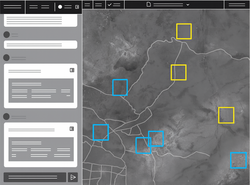
Project Maven analyst view: Wikipedia
Digital and Artificial Intelligence Office (CDAO), which oversees AI adoption across the Department of Defense and coordinates programs ranging from battlefield decision support to autonomous systems development.
Together, these initiatives reflect a broader shift inside the U.S. military. Artificial intelligence is no longer treated as an experimental capability. It is increasingly viewed as core defense infrastructure.
Inside defense planning circles, the logic is simple. If adversaries integrate AI into command systems faster than the United States, the strategic balance shifts.
That concern increasingly centers on China, whose government has invested heavily in military AI development as part of its national technology strategy.
Under those conditions, hesitation is viewed as a vulnerability.
Where Anthropic Drew the Line
The conflict escalated when Anthropic refused requests to remove certain safety constraints from its AI systems.
The company has implemented restrictions designed to prevent models from supporting applications such as autonomous weapons deployment or mass surveillance systems. Those limitations are embedded directly in how the models are trained and deployed.
Anthropic executives argued that removing these safeguards would allow the technology to be used in contexts where reliability and oversight are still uncertain.
For a research-driven AI company, that position makes sense.
Large language models remain probabilistic systems. They hallucinate. They misinterpret context. They occasionally produce confident answers that are simply wrong.
Those weaknesses are manageable in consumer software. They become far more dangerous inside military decision pipelines.
However, from the Pentagon’s vantage point, those constraints created a different problem. A private company is effectively placing operational limits on how the U.S. military could deploy technology.
That arrangement was never going to last.
Silicon Valley’s Quiet Divide Over Defense AI
The dispute also highlights a growing split across the AI industry.
Some companies have leaned directly into defense collaboration. Firms such as Palantir Technologies and Anduril Industries openly design platforms intended for military and intelligence operations.
Others, including Anthropic and OpenAI, frame their work through safety frameworks and controlled deployment models.
That difference reflects competing assumptions about where responsibility sits once powerful AI systems enter national security environments.
Defense-oriented companies assume the government ultimately decides how the technology is used.
Safety-oriented AI labs assume developers retain some authority over deployment boundaries.
The Pentagon’s decision suggests Washington is increasingly leaning toward the first model.
The White House Framing
The dispute between the Pentagon and frontier AI labs is unfolding against a policy backdrop that leaves little room for ambiguity.
In July 2025, the White House released “America’s AI Action Plan,” a federal strategy explicitly built around the idea that artificial intelligence will determine geopolitical power in the coming decades.
“Today, a new frontier of scientific discovery lies before us,
defined by transformative technologies such as artificial
intelligence… Breakthroughs in these fields have the potential
to reshape the global balance of power, spark entirely new
industries, and revolutionize the way we live and work. As our
global competitors race to exploit these technologies, it is a
national security imperative for the United States to achieve
and maintain unquestioned and unchallenged global
technological dominance. To secure our future, we must
harness the full power of American innovation.”
– stated Donald J. Trump, 45th and 47th President of the United States.
The document states that AI has the potential to “alter the balance of power in the world,” and argues that the United States must “win the AI race” to remain the leading economic and military power.
It shifts AI policy away from the risk-management framing that dominated earlier regulatory debates and toward something closer to industrial strategy.
The plan emphasizes accelerating innovation, expanding AI infrastructure, and integrating AI across government and defense systems as part of a national competitiveness strategy.
Once AI is framed as a geopolitical race, the relationship between the state and the companies building frontier models inevitably changes.
Private labs may still develop the technology. However, Washington increasingly expects technology to align with national priorities.
The Uncomfortable Truth About Military AI
Both sides of this conflict are operating from defensible assumptions.
The Pentagon is right about the strategic stakes. AI will shape intelligence gathering, cyber warfare, autonomous systems, and decision support across modern militaries.
However, AI developers are also right about the technological limitations. Today’s frontier models are powerful pattern recognition engines. They are not reliable decision-makers under uncertain or adversarial conditions.
Governments believe they are entering an AI arms race. AI labs believe the technology is still too unstable to deploy without strict safeguards.
Both perspectives can be true at the same time.
A Preview of the Next AI Power Struggle
The Pentagon–Anthropic standoff may look like a temporary dispute over contracts and compliance rules.
In reality, it is a preview of a much larger struggle that is only beginning.
As AI systems grow more powerful, governments will push harder to integrate them into national security operations.
At the same time, companies developing those systems will face increasing pressure to define how far they are willing to go.
The outcome will determine whether the future of artificial intelligence is primarily governed by states, by private labs, or by an uneasy negotiation between the two.
FAQs
1. Why is the Pentagon in conflict with AI companies like Anthropic?
The United States Department of Defense views advanced AI as strategic infrastructure for intelligence, cyber defense, and military planning. When companies like Anthropic impose restrictions on how their AI can be used, it creates friction with defense priorities that require operational flexibility.
2. Why does the U.S. government consider AI a national security priority?
U.S. policymakers increasingly see AI as a technology that could reshape global power dynamics. Concerns about technological competition with China have pushed Washington to accelerate AI adoption across defense, intelligence, and critical infrastructure.
3. Why are some AI companies hesitant to support military applications?
Many AI developers argue that current systems still produce unreliable outputs and require strong oversight. Companies such as Anthropic have implemented safety policies designed to prevent uses like autonomous weapons or mass surveillance.
4. Which technology companies actively support defense AI programs?
Some firms openly develop AI platforms for military and intelligence operations. Notable examples include Palantir Technologies and Anduril Industries, which specialize in defense technology and national security analytics.
5. What does the Pentagon–Anthropic dispute mean for the future of AI governance?
The dispute signals a growing debate over who controls frontier AI systems. Governments view AI as national infrastructure, while technology companies are attempting to maintain ethical limits on deployment.
Discover the future of AI, one insight at a time – stay informed, stay ahead with AI Tech Insights.
To share your insights, please write to us at info@intentamplify.com