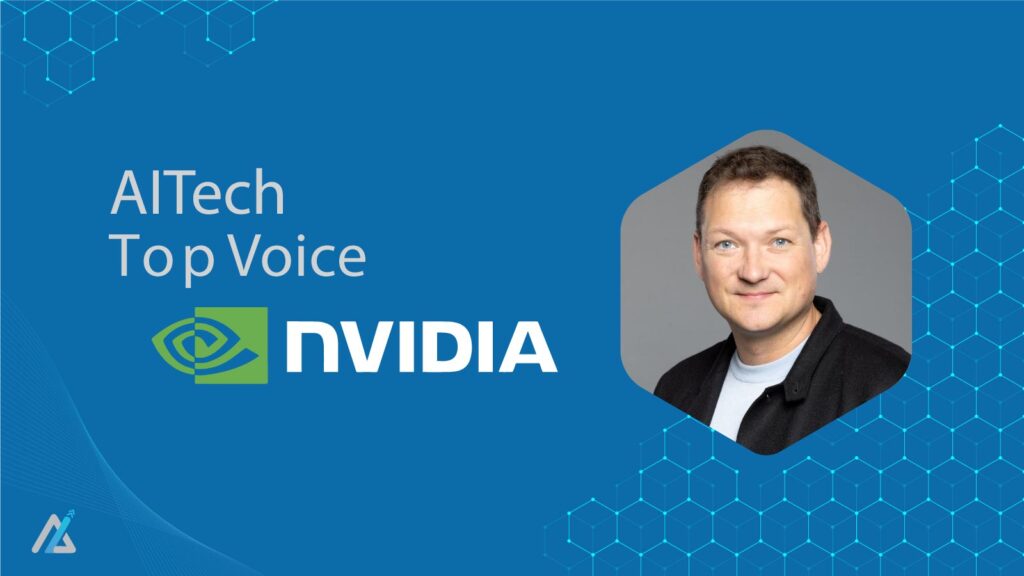
Welcome to the AITech Top Voice Interview Series, where we speak with global leaders shaping the future of artificial intelligence across science, industry, and society. I’m Sudipto Ghosh, your host, and in this edition, we’re exploring one of the most consequential intersections of AI and climate science.
Today, I’m joined by Mike Pritchard, Director of Climate Simulation Research at NVIDIA Research, and one of the key contributors behind the landmark NVIDIA Earth-2 launch. Mike leads a multidisciplinary team of AI researchers and climate scientists focused on advancing next-generation weather and climate modeling. With over a decade of experience as a professor of Earth system sciences, he also brings deep academic rigor to applied AI innovation and is a co-author of the three scientific papers released as part of the Earth-2 initiative.
The Earth-2 launch represents a pivotal moment in AI development—bringing together open, production-ready AI models for medium-range forecasting, short-term nowcasting, and global data assimilation into a unified, end-to-end system. In this conversation, we’ll dive into what makes Earth-2 a milestone for the AI community, the architectural and training breakthroughs behind its performance, and how NVIDIA is enabling global collaboration, accessibility, and responsible AI adoption through open and modular design.
Mike, it’s a pleasure to have you here. Let’s begin by talking about your role at NVIDIA and your contributions to the Earth-2 launch.
Here’s the full interview.
AI Technology Insights (AIT): Mike, welcome to the AITech Top Voice interview series. Please tell us a bit about your role at NVIDIA and how you contributed to the NVIDIA Earth-2 launch.
Mike Pritchard: Hi! I’m Mike. I lead a team of AI researchers and climate scientists who develop technology for Earth-2. I was a professor of earth system sciences for a dozen years and am a co-author on the three new scientific papers that were released as part of the NVIDIA Earth-2 launch.
Recommended: AITech Top Voice: Interview with Jeremy Burton, CEO at Observe
AIT: What makes EARTH-2 LAUNCH a milestone event in the AI development world?
Mike Pritchard: The Earth-2 launch is a milestone because it brings three new, open, production-ready AI weather models together into a complete system. With Earth-2 Medium Range, Earth-2 Nowcasting, and Earth-2 Global Data Assimilation, we now have an end-to-end AI pipeline that spans everything from initializing atmospheric conditions to global forecasts and short-term severe weather prediction.
Earth-2 Medium Range delivers accurate global forecasts out to 15 days and outperforms leading open models across most commonly evaluated variables. Earth-2 Nowcasting focuses on the most time-sensitive window—0 to 6 hours—delivering kilometer-scale predictions that outperform physics-based benchmarks for short-term precipitation. Global Data Assimilation replaces traditionally complex, compute-heavy initialization workflows with an AI approach that runs in minutes. Combined with existing Earth-2 capabilities like CorrDiff, this launch shows how AI can significantly improve the speed, accuracy, and accessibility of weather forecasting.
These pretrained models sit alongside frameworks, customization recipes and inference libraries that are all entirely open-source. This launch marks the first time these disparate weather and climate AI capabilities have been brought together, giving organizations the ability to run models on their own infrastructure, fine-tune on proprietary observations, and deploy for mission-critical operations.
AIT: What specific advancements in AI architectures or training techniques enabled Earth-2 to outperform traditional and earlier AI weather models in both short-term and medium-range forecasting?
Mike Pritchard: The performance gains stem from advances across model architecture, training data, and system design. Earth-2 Medium Range uses a new architecture optimized for learning global atmospheric dynamics across more than 70 weather variables, enabling accurate forecasts out to 15 days. Training on decades of observational and reanalysis data allows the model to capture complex spatial and temporal patterns at scale. It uses diffusion transformers within a crafty multi-scale time-stepper framework that applies probabilistic ML to the macroscale time evolution and deterministic ML to the fine scale evolution.
Earth-2 Nowcasting is trained directly on high-frequency satellite and radar observations, enabling kilometer-scale predictions for short-term severe weather in the critical 0–6 hour window. It uses sparse neighborhood attention via scalable diffusion transformers that can be parallelized across GPUs to enable both high resolution and continental domain sizes.
Earth-2 Global Data Assimilation introduces an AI-based approach to generating initial atmospheric conditions, replacing traditionally complex workflows with a faster, more efficient process. It uses standard vision transformers but takes care to modularize the state estimation task from the prediction task for improved understanding of the overfitting challenges unique to the initialization task.
Together, these models demonstrate how AI can improve forecast accuracy, speed, and scalability across both short- and medium-range time horizons.
Recommended: AITech Top Voice: Interview with Dana Simberkoff, Chief Risk, Privacy, and Information Security Officer at AvePoint
AIT: How does Earth-2’s open and modular design support collaboration with external researchers, governments, and enterprises, and what tools or APIs are planned to strengthen this ecosystem?
Mike Pritchard: Earth-2 is designed as a modular system, allowing organizations to adopt individual models or deploy the full end-to-end pipeline. This flexibility supports collaboration with researchers, governments, and enterprises that operate under different infrastructure, data, and sovereignty requirements.
All Earth-2 models are released with open weights, training recipes, and documentation under the NVIDIA Open Model License, enabling transparency, reproducibility, and customization. Tools like Earth2Studio provide a common Python interface for running, evaluating, and extending models, lowering the barrier to experimentation and deployment.
By combining newly released models with existing Earth-2 capabilities such as CorrDiff, NVIDIA is enabling a broad ecosystem where partners can build sovereign forecasting systems, integrate domain-specific data, and advance AI weather research collaboratively.
AIT: What strategies are being used to validate Earth-2’s forecasts across diverse geographies and extreme weather conditions, and how are improvements measured against physics-based systems?
Mike Pritchard: NVIDIA Earth-2 provides models and tools so that our partners can produce weather forecasts, but we do not provide these forecasts ourselves. Instead, our goal is to provide state-of-the-art models that partners can adopt for their specific regions or expertise.
In our scientific papers, Earth-2 models are validated using rigorous benchmarks against high-quality reanalysis datasets such as ERA5, with evaluation across key variables including temperature, wind, and precipitation. Prediction performance is measured using standard probabilistic skill metrics and assessed against well-known strong physics-based and deep learning based baselines. Earth-2 Medium Range is benchmarked on standard forecasting metrics and consistently outperforms leading open models across most commonly evaluated variables at medium-range lead times.
Earth-2 Nowcasting is evaluated on short-term precipitation and storm dynamics, where it surpasses established physics-based models in the first hours of forecasting. Earth-2 Global Data Assimilation is assessed by comparing forecasts initialized with AI-generated states against those using industry-standard reanalysis, showing comparable accuracy at a fraction of the time and computational cost.
These validation strategies ensure Earth-2 models perform reliably across geographies, weather regimes, and extreme events, and that improvements are meaningful in operational forecasting contexts.
Recommended: AITech Top Voice: Interview with Peter Weckesser, Chief Digital Officer at Schneider Electric
AIT: How is NVIDIA driving global AI awareness and adoption—especially across emerging markets, academia, and public sector organizations—through initiatives connected to platforms like Earth-2?
Mike Pritchard: NVIDIA is expanding access to advanced AI weather capabilities by making Earth-2 models open and deployable on local infrastructure, allowing nations and organizations to build and operate their own forecasting systems. By reducing dependence on large, centralized supercomputing resources, Earth-2 lowers technical and cost barriers for academia, public sector institutions, and regions with limited infrastructure.
Earth-2 Medium Range, Nowcasting, and Global Data Assimilation are available through Earth2Studio, Hugging Face, and NVIDIA NGC, supported by documentation, reference workflows, and training from the NVIDIA Deep Learning Institute.
NVIDIA also works with national meteorological agencies, researchers, and industry partners to support operational use and knowledge sharing.
This approach ensures that high-quality AI weather models are broadly accessible and can be validated, adapted, and deployed across diverse global contexts.
AIT: Beyond Earth-2, what broader programs or partnerships is NVIDIA leading to educate global communities on the responsible, ethical, and societal impact of AI?
Mike Pritchard: NVIDIA supports responsible AI development through open-models that emphasize transparency, reproducibility, and broad access. By releasing models with open weights, training data descriptions, and recipes, NVIDIA enables independent validation and encourages collaboration across the global research and developer community.
To share your insights, please write to us at info@intentamplify.com