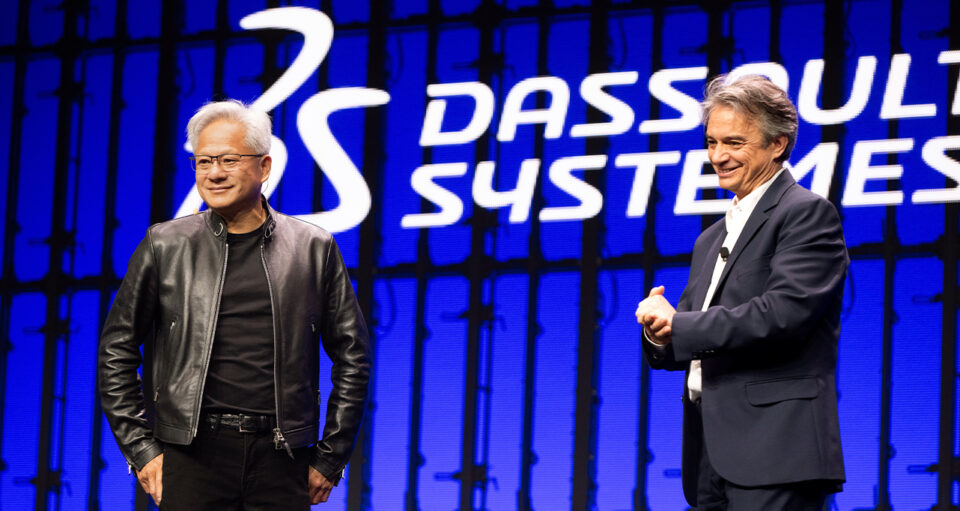
Dassault Systèmes, the French software company known for its 3DEXPERIENCE virtual twin technologies, and NVIDIA, the AI and accelerated computing leader, have announced a major expanded strategic partnership aimed at building a next-generation industrial AI platform grounded in physics and real-world simulation.
The pact was unveiled at the 3DEXPERIENCE World and represents one of the largest collaborations between the two companies in over 25 years.
From Digital Twins to “Physical AI”
At the heart of the collaboration is the goal of moving beyond traditional AI models that generate or predict data toward “physical AI” — AI systems that are grounded in the laws of physics and real-world behavior. This shift means AI will not just process information but understand and simulate how complex systems behave before anything is physically built.
The partnership combines:
• Dassault Systèmes’ Virtual Twin technology from the 3DEXPERIENCE platform, which creates detailed digital replicas of products, factories, and processes.
• NVIDIA’s AI infrastructure, open models, and accelerated computing libraries that power large-scale simulation and machine-learning workflows.
Together, these will form science-validated “Industry World Models” — comprehensive simulations that serve as mission-critical AI systems for industries ranging from biology to manufacturing and materials science.
What This Platform Enables
According to the companies:
Virtual Companions: AI agents powered by NVIDIA open models and Dassault’s world models will act as intelligent guides, helping engineers and researchers explore designs and make decisions with deep contextual knowledge.
Industrial AI Factories: Through Dassault’s OUTSCALE cloud strategy, NVIDIA infrastructure will be deployed on three continents, enabling secure, sovereign operation of AI models at scale.
Cross-Industry Applications: The combined stack aims to accelerate biology and materials discovery, improve predictive design and engineering workflows, and enable autonomous, digitally validated production systems.
Strategic Vision
NVIDIA CEO Jensen Huang described this effort as a reinvention of how industrial computing works, emphasizing that “artificial intelligence will be infrastructure” in the same way past generations viewed electricity and the internet as foundational.
“Physical AI is the next frontier of artificial intelligence, grounded in the laws of the physical world,” said Huang. “Together with Dassault Systèmes, we’re uniting decades of industrial leadership with NVIDIA’s AI and Omniverse platforms to transform how millions of researchers, designers and engineers build the world’s largest industries.”
Pascal Daloz, CEO of Dassault Systèmes, highlighted that “AI that is grounded in science, physics, and validated industrial knowledge becomes a force multiplier for human ingenuity.”
AI Tech Insights Analysis
This partnership is less about another AI integration and more about a structural shift in how industrial intelligence gets built. Most enterprise AI deployments still sit at the analytics layer. Dashboards. Forecasts. Optimization models trained on historical data. Useful, but reactive. What Dassault Systèmes and NVIDIA are proposing moves AI upstream, into the physics layer itself.
In sectors like aerospace, automotive, life sciences, energy, and advanced manufacturing, design errors are expensive, slow, and often irreversible once production begins. Physical AI grounded in validated simulations effectively compresses that risk. Engineers can test thousands of permutations virtually, train AI agents inside those environments, and deploy only what already performs reliably under stress.
This changes AI from a decision-support tool into an operational co-pilot.
It also signals a broader trend. Industrial AI is becoming infrastructure, not a feature. Much like cloud computing or CAD systems in earlier cycles, platforms that combine simulation, compute, and intelligence will likely become default operating layers for complex enterprises.
Competitive advantage may no longer come from who has the best standalone model. It will come from those who own the richest, most accurate world model—the deepest representation of how their products, factories, and supply chains respond.
That is where this partnership lands, not as a press-release collaboration, but as an attempt to define the operating system for next-generation industrial AI.
Explore how NVIDIA’s AI weather breakthroughs are reshaping forecasting and risk planning — read more here.
FAQs
1. What makes this different from a typical AI partnership?
This isn’t analytics on top of data. It embeds AI inside physics-based simulations. The model understands how systems behave before anything is built.
2. What is “physical AI” in practical terms?
AI trained inside validated digital twins. It learns constraints like stress, heat, and materials, not just patterns in historical data.
3. Who benefits most from this platform?
Aerospace, automotive, life sciences, energy, and advanced manufacturing. Anywhere design mistakes are costly and irreversible.
4. Why combine NVIDIA compute with Dassault’s twins?
Simulation needs massive parallel computing. NVIDIA handles scale. Dassault provides the real-world models. Together, they form an executable world model.
5. What’s the long-term implication for enterprises?
Industrial AI becomes infrastructure. Competitive advantage shifts from standalone models to owning the most accurate digital representation of reality.
Discover the future of AI, one insight at a time – stay informed, stay ahead with AI Tech Insights.
To share your insights, please write to us at info@intentamplify.com