

Microsoft has made Copilot a key AI innovation tool for productivity use across different platforms. However, the various industry reports and analyses of the adoption of the tool tell a different story. They suggest that the actual use of the tool is low and inconsistent, thus creating a big gap between the announced AI strategy and the day-to-day working reality in the field.
Microsoft AI Mandate
On the face of it, the use of artificial intelligence was the centerpiece of Microsoft’s strategy around which all other strategies were planned. The company embedded Copilot across Microsoft 365 and Windows, intending to revolutionize routine workflows.
Microsoft is marketing Copilot mainly as a manifestation of their bigger faith that AI is going to revolutionize knowledge work. CEO, Satya Nadella has been saying many times that AI is a ‘once-in-a-generation’ kind of change, and he explains that it will completely change the way businesses run and compete.
The company is basically betting on this big change, which is why they have made the Copilot feature available in all their essential products and have promoted its use throughout the whole company.
“AI is the defining technology of our time. It’s transforming how we work, how we live, and how we solve problems across every industry, ” shared Nadella, on AI becoming foundational to work.
Contrary to that, independent adoption data and research by experts reveal that the level of usage is much lower than expected. The analysis of 37.5 million anonymous Copilot interactions in great detail showed that the engagement patterns were diverse and that the majority of users chose to use the tool for general questions instead of deep productivity workflows – thus highlighting that simply providing access does not guarantee usage, which is continuous.
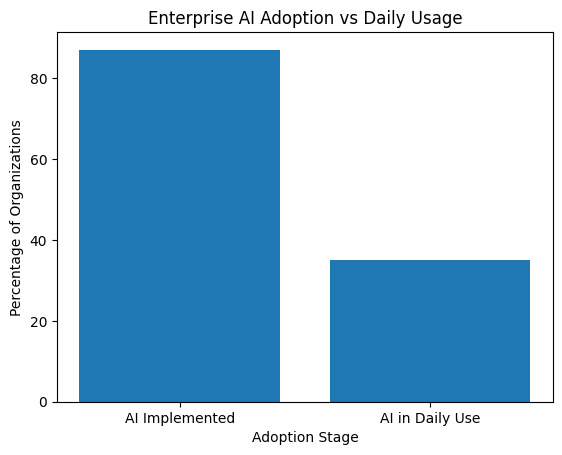
Theoretically, this phenomenon should also be true for AI in business in general: as per the latest data, 87% of big companies declare that they have implemented AI solutions, but only very few of them have managed to move beyond the pilot phase and have AI in full production. This reveals that adoption and return on investment problems still persist.
There Are Several Reasons Why Adoption is Slow
Experts are of the opinion that a number of structural factors exist in an enterprise that affect the uptake of Copilot:
Behavioral and Workflow Gaps
Studies indicate that in most cases, companies simply regard the launching of Copilot as a standard software project, whereas in reality, it is a radical AI change that results in minimal changes in employee behavior. If employees are not deeply involved in the integration of the tool into their daily work, they will most likely stick to their old, pre-AI ways of working.
Governance and Security Concerns
As per a 2025 Gartner survey, 71% of the leaders in the enterprise sector point to governance and security as reasons for the most significant difficulties in scaling the deployment of Copilot, with 69% of them being not very clear about the return on investment, thus manifesting reluctance coming from the whole organization in terms of data protection and compliance when it comes to AI.
Unclear Impact Metrics
Many enterprises are still not in a position to set up robust frameworks necessary for measuring business value derived from the use of Copilot. Another analysis of adoption trends pinpointed that some organizations had reported productivity improvements in specific tasks, while quantifying overall productivity had remained an unattainable goal – hence, a majority of them are still hesitant about full implementation.
Microsoft’s Perspective and Efforts to Close the Gap
Microsoft is aware that unlocking the full potential of Copilot requires comprehensive measurement and governance structures. The company’s Digital AI Value Framework (MAIVA) serves as a guide to evaluate the impact of AI through various metrics related to productivity, security, and quality improvement – thus indicating a move towards a more structured way of assessing the value of AI.
Furthermore, Microsoft provides a formal adoption report template that helps organizations internally benchmark Copilot usage. This suggests that the company realizes that the widespread use of AI cannot be left to chance but needs to be deliberately measured and managed continuously.
What This Means for Enterprise AI Leaders
The present state of Copilot adoption is just one example of the challenge faced by enterprise AI leaders in general. It shows that having just the right strategic imperatives is not enough. To be able to turn the mere existence of AI into a consistent and critical use, organizations must solve the issues of culture, governance, workflow integration, and measurable ROI.
Experts recommend that companies implement structured change management, create governance frameworks, and set well-defined success metrics so as to be able to move beyond pilot projects and integrate AI in a meaningful way.
While on one hand, a greater number of case studies along with maturing enterprise frameworks could lead to wider and deeper use of tools such as Copilot, on the other hand, this journey demands careful preparation rather than just making strategic declarations.
Conclusion
Microsoft’s efforts to spread the use of Copilot throughout its ecosystem are an indication of a general industry trend of AI-augmented work. Nevertheless, adoption data and enterprise research point out that just being available does not necessarily mean that tools will be used daily or that productivity will be transformed.
The gap between these two will still be a major challenge for enterprise AI strategy in 2026 and later on, when companies will be trying to convert AI potential into measurable business impact.
FAQs
1. Why hasn’t Microsoft Copilot seen widespread internal adoption yet?
Because access alone doesn’t change behavior, many employees are still figuring out where Copilot actually fits into their daily work, especially when existing workflows already feel “good enough.”
2. If AI is a priority at Microsoft, why are employees hesitant to use Copilot?
Priority at the leadership level doesn’t always translate on the ground. For many teams, the value of Copilot isn’t immediately obvious, and without clear guidance, people tend to revert to familiar ways of working.
3. Does low Copilot usage suggest a flaw in Microsoft’s AI strategy?
Not necessarily. It points more to an execution challenge than a technology issue. Even well-designed AI tools struggle when change management and real-world incentives lag behind ambition.
4. Is Microsoft’s experience with Copilot unique in the enterprise AI space?
No. Many large organizations face the same issue. AI tools are rolled out quickly, but adoption slows when employees aren’t shown how those tools save time in practical, everyday tasks.
5. What should enterprise leaders learn from Microsoft’s Copilot rollout?
That AI success depends less on mandates and more on usability, trust, and habit-building. Tools gain traction when they clearly make work easier, not just more advanced.
Discover the future of AI, one insight at a time – stay informed, stay ahead with AI Tech Insights.
To share your insights, please write to us at info@intentamplify.com