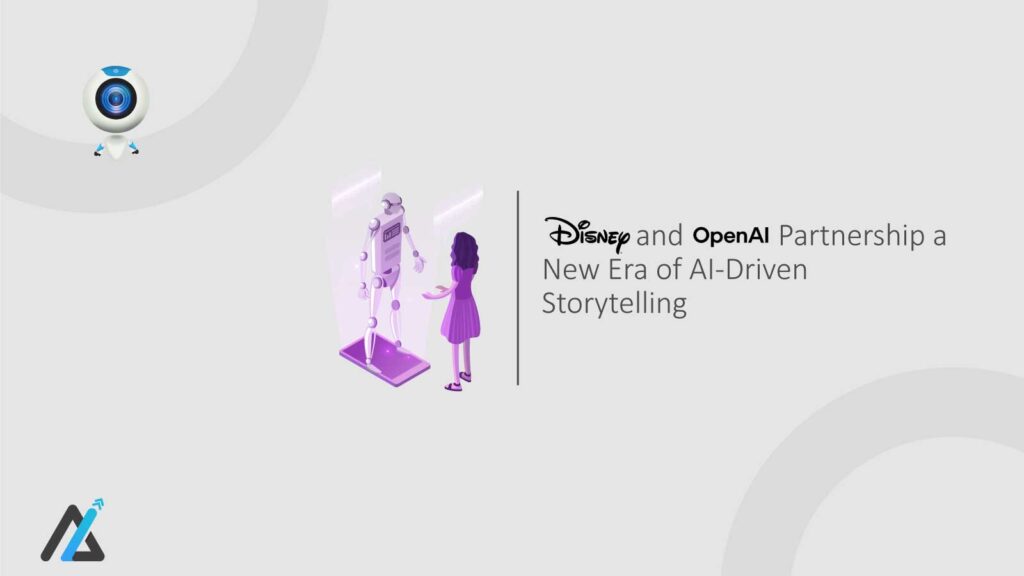
The media industry might change overnight with the news of a Disney and OpenAI partnership signaling the start of a new era of AI-powered narrative. Imagine if Mickey Mouse and Iron Man were employed in tailored, AI-generated plots that users could help design.
The landmark collaboration in artificial intelligence and entertainment: Walt Disney Co. struck a landmark three-year deal with OpenAI in December 2025, comprising a $1 billion equity infusion and a licensing agreement for OpenAI’s Sora generative video platform.
Through the agreement, the filmmakers are given permission to create short AI videos that feature characters (up to 200) from the Disney, Marvel, Pixar, and Star Wars universes.
This step will make Disney the first big content licensing partner on Sora. It indicates a major turning point in the interaction of branded intellectual property with generative AI.
Here’s Why: The relationship between intelligent automation and storytelling
The global market for AI in media and entertainment is expected to increase from roughly $25.98 billion in 2024 to almost $99.48 billion by 2030, with a compound annual growth rate (CAGR) of 24.2%.
At present, generative AI tools are progressively influencing content creation, personalization, and distribution. These tools, on one hand, analyze user preferences to a great extent and, on the other, provide real-time solutions in terms of content or recommendations, thereby not substituting but supplementing human creativity.
Once again, by implementing OpenAI’s Sora, Disney follows the global trend of content creation powered by AI and is a forerunner in entertainment innovation.
The awe-inspiring creative power of AI: From concept to film
Artificial intelligence today accomplishes much more than just task automation. It helps creative practitioners explore their ideas more rapidly by producing the visuals of an idea, offering unexpected narrative for the story, and, of course, facilitating the whole process by quickening the iteration cycles.
For instance:
- Idea generation: By a machine, unlimited story possibilities are generated, and a writer chooses only one.
- Visual previews: The very first versions of the scenes or the characters’ actions can be exhibited within 5-10 minutes.
- Audience personalization: The AI always keeps track of the pattern of interaction, and then it easily foresees the preferences of targeted viewers.
This partnership of human and AI creativity is a perfect storytelling fuel, which not only can be unique for every fan, but can also retain the emotional connection.
Disney and OpenAI Partnership: What Comes Next
In this partnership, creators, along with fans, are facilitated by the use of Sora in making short videos that show the characters that everyone loves. Some of the videos are set to be released on Disney+ in 2026, thus broadening the ways the audience can interact with the stories and the franchises.
Disney is going to use OpenAI innovations like ChatGPT as well to promote productivity and spark new ideas in their different divisions.
This mixture of art and technology is an excellent example of how generative AI can be used to come up with new creative ideas, which is not the main idea.
Balancing Innovation with Responsibility
Besides the massive creative power, Disney also has to take responsibility into account. To make sure the characters are used in a justified way and to prevent copyright infringements, Disney’s licensing agreement includes security features that are meant to address these issues.
Moreover, OpenAI keeps on improving the safety features with every update, which in turn results in better handling of copyrighted matter and user interactions.
Proper use of the technology will be the key when the whole entertainment industry follows the footsteps of such partnerships.
Industry Trends Behind the Move
It is interesting to know that big companies like Disney don’t treat AI as a mere gadget – they fully embrace AI technology as per the below sources:
One of the biggest advantages is the technology’s capability to help companies personalize content and recommend it to consumers who will most probably be interested in it.
At the same time, AI assists in cutting down the production time, thus lowering the brand’s operational costs.
Moreover, AI can be the perfect companion in this field, where it can create immersive worlds with interactive stories for users.
All these are direct inputs for the why of the Disney and OpenAI partnership, which is making a lot of sense from a strategic perspective. It serves as a perfect bridge, reaching between the past and the future of creativity by exploring new ways for fans to enjoy the characters of their favorite stories while fulfilling their expectations of customized interaction.
What is the implication of this beyond the headlines?
It is a transition from the old paradigm where the users of the content played a passive role to the new one where they become active co-creators. It is conceivable that the audience could influence the storylines as much as the studios, thus deepening their emotional ties and opening uncharted territories of monetization.
For industry leaders, this is not a step forward. It is a fundamental shift in the narrative organization, production, and consumption processes.
Conclusion
The tie-up between Disney and OpenAI is a clear sign of change in the entertainment world that spans across generations. It combines the best of two worlds- the technological innovations talents with the narrative heritage riches.
As AI instruments get more intertwined with creative processes, storytelling becomes way broader than ever before. The upcoming stories will be more personalized, more co-created with the audience, and more facilitated by smart systems that will be the collaborators of human creativity rather than working separately.
FAQs
1. Why is the collaboration between Disney and OpenAI so important?
It marks a first major instance where a top entertainment firm formally provides a license for the use of its characters in generative AI content, which in turn greatly changes creative workflows.
2. Is there a possibility that AI will completely substitute human storytellers?
No. The AI’s main function is to enhance human creativity through a more efficient production process. It will also open up new ways of expression while still keeping the emotional aspect intact.
3. When can we watch AI-generated content from their partnership?
Sora-generated content with Disney characters that have been selected will be available on Disney+ from 2026 onwards.
4. What measures will be taken to secure intellectual property?
The pact comes with the provision of certain controls over the content and safety measures that are aimed at characters and creative components being used in a respectful manner and in line with the brand.
5. What is the reason behind such a massive investment by companies in AI for media?
Generative AI fundamentally is the source for a number of advantages in media: personalization is taken to a higher level, production expenses are lowered, and audience engagement is enriched. These factors are the main drivers for the media landscape’s growth.
Stay Ahead with AI Tech Insights.
To share your insights, please write to us at info@intentamplify.com