
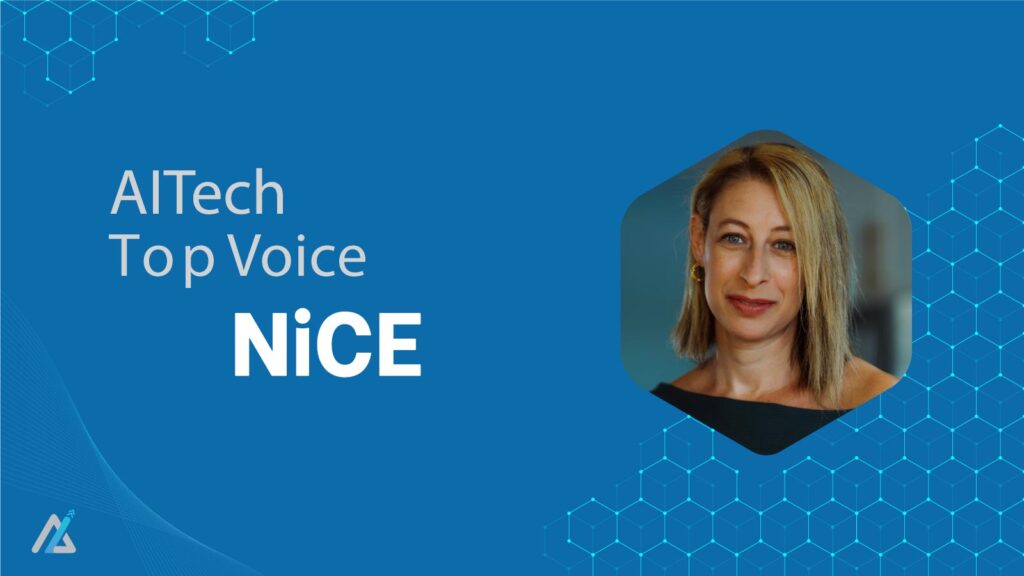
In this edition of the AI Technology Top Voice Interview series, we sit down with Carmit DiAndrea, Director of AI Data Management at NiCE. Carmit leads the charge in harnessing the power of AI and data to transform digital customer experiences, ensuring that interactions are smarter, more personalized, and ethically managed at scale.
In our conversation, Carmit shares her insights on AI data management, conversational and generative AI, and how NiCE is using these technologies to deliver seamless, unified customer experiences. We also explore the company’s recent acquisition of Cognigy, the role of governance in AI-driven CX, and the emerging trends that are shaping the future of AI-powered customer engagement.
About Carmit DiAndrea: Carmit DiAndrea is a contact center, analytics, and AI expert with over 20 years of experience translating customer feedback, operational, and contact center data into business strategies that drive impact. At NiCE, she leverages the company’s extensive interaction data assets to develop innovative AI and Generative AI-powered solutions that advance the digital customer experience. Carmit has held leadership roles at Blue Shield of California, Verint Systems, Spectrum/Time Warner Cable, Concentra, and TPG TeleManagement. She is also an educator, teaching statistics, research methods, and algebra as an adjunct instructor at Kaplan and National American Universities.
About NiCE: NiCE is a leader in digital customer experience, powering billions of interactions each year through solutions like AI Copilots, Intelligent Virtual Agents, and AI Orchestrator. With a focus on security, transparency, and innovation, NiCE helps enterprises deliver seamless, personalized experiences across customer touchpoints while maintaining trust and compliance.
Here’s the full interview.
AI Technology Insights (AIT): Hi, Carmit. Welcome to the AI Technology Top Voice Interview Series. To start, can you tell us a bit about your role at NiCE and the path that brought you into leading AI data management for customer experience?
Carmit DiAndrea: At NiCE, I serve as Director of AI Data Management. I’m responsible for shaping how AI and data come together to drive smarter, more personalized experiences at scale. Over the past two decades, I’ve held leadership roles spanning analytics, consulting, Go To Market and product strategy, which gave me valuable insights into how data, AI and customer experience strategies must align to deliver real impact. At NiCE, that perspective translates into helping our teams design solutions where AI not only performs at scale but also remains transparent, ethical, and trustworthy.
After 15 years of solving business problems with data, I discovered a powerful new tool: AI-powered Interaction Analytics. I’ve been fascinated with leveraging AI in the CX space ever since!
Recommended: AITech Top Voice: Interview with Stephen Senterfit, President at Smartbridge
AIT: From your perspective, what does “AI data management” mean within the context of a leader in digital customer experience like NiCE, and how does it uniquely enable the company’s unified CX platform?
Carmit DiAndrea: AI data management is about creating a disciplined framework for how customer data is collected, cleansed, structured, integrated and activated for AI-driven experiences. For our customers and their consumers, data is the foundation of what creates a truly unified platform that delivers seamless multimodal experiences from routing to powering an AI or human agent, into the mid and back office across various orchestrated workflows. Without strong data management, AI becomes limited. With it, we enable AI to be accurate, contextually aware and scalable, and that’s what allows enterprises to personalize experiences at scale.
AIT: NICE is known for powering billions of customer interactions per year and for solutions like AI Copilots, Intelligent Virtual Agents, and AI Orchestrator — how do you approach managing the data that fuels these AI-powered capabilities effectively, securely, and at scale?
Carmit DiAndrea: It begins with governance. We operate under principles of security, transparency, compliance, and fairness. Our platform processes billions of interactions, and every one of those touchpoints is managed with privacy safeguards, anonymization where needed, and monitoring to detect anomalies.
AIT: NiCE recently announced its acquisition of Cognigy, a leader in conversational AI. From your perspective, how does this deal enhance NiCE’s AI and CX portfolio, and what impact do you see it having on enterprises looking to deliver smarter, more automated customer interactions?
Carmit DiAndrea: Cognigy is a perfect complement to our vision of an AI-first customer experience. Conversational AI isn’t just about automating routine tasks — it’s about creating intelligent, human-like interactions that integrate seamlessly into enterprise workflows. By bringing together Cognigy’s enterprise-grade conversational and agentic AI with our purpose-built CXone Mpower platform, we can deliver more natural conversations, tighter connections to business processes, and faster deployment of self-service and agent augmentation use cases.
A key benefit for customers is that Cognigy will be available both as part of CXone Mpower and as a standalone offering, giving enterprises the flexibility to adopt AI in the way that best fits their business and technology strategies. For enterprises, that translates into lower costs, greater efficiency, and the ability to scale AI across every customer touchpoint with confidence.”
Recommended: AITech Top Voice: Interview with Paul Walker, Field CTO at Omada
AIT: Reflecting on your experience across organizations and your academic background, how have you integrated best practices in data governance, analytics, and CX into your current role, and how did those experiences shape your leadership there?
Carmit DiAndrea: My academic background is in Statistics. When I was an undergrad, I remember walking into my first statistics class and the professor handing out a cartoonish-looking book titled ‘How to Lie With Statistics.” He told us to read it cover to cover and that he never wanted to see anything from that book in our work. A few years later, when I was building my first analytics team, I made my team read that same book. As data practitioners, our first responsibility must be to take proper care of the data, the way we use it, and the stories we tell with it.
Good governance isn’t just about compliance — it’s about ensuring the data is fit for purpose, ensuring that the outcomes of the activities undertaken with the data – whether analytics or more complex model development – deliver on the intended outcomes.
In my leadership role at NiCE, I emphasize a balance: rigorous governance standards coupled with innovation so we never lose sight of trust while pushing the boundaries of what AI can deliver.
AIT: The intersection of AI, analytics, and customer experience governance is complex. What are the key Pillars or philosophies you rely on to ensure that data initiatives both advance innovation and preserve trust and compliance?
Carmit DiAndrea: My framework is built around four pillars: transparency, accountability, fairness, and agility. Transparency ensures stakeholders understand how AI solutions are using data and making decisions. Accountability means every model has clear oversight. Fairness ensures bias is detected and mitigated. Agility allows us to adapt as regulations and technology evolution at the speed of business. Together, these pillars give us both the discipline to safeguard customer data and the flexibility to innovate responsibly.
AIT: Could you share a real-world example—perhaps a use case involving NICE’s AI Copilots, workforce engagement, or service automation—where effective AI data management unlocked measurable improvements in customer satisfaction or efficiency?
Carmit DiAndrea: A strong example is Great Southern Bank in Australia. By expanding its implementation of CXone Mpower (with advanced features like AI-driven Interaction Analytics, omnichannel routing, and real-time sentiment insight), the bank significantly reduced customer wait times—now ~80% of calls are answered within 30 seconds. It also improved how it handles high volumes of enquiries, especially for vulnerable customers, enabling more efficient workflows and a more immediate response in urgent situations.
Recommended: AITech Top Voice: Interview with James Taylor, Head of Enterprise Transformation Platforms at DXC Technology
AIT: As AI-powered solutions become more autonomous, how do you evaluate and mitigate risks such as data bias, privacy exposure, or skewed outcomes in your data pipelines?
Carmit DiAndrea: We build monitoring and governance into the pipeline itself. Bias detection models, privacy filters, and human-in-the-loop reviews are all standard practices. Just as importantly, we leverage AI observability dashboards that give teams real-time visibility into how their AI solutions are using data, making decisions and performing against KPIs. This visibility enables business leaders to constantly monitor and improve the performance of these solutions.
AIT: Looking ahead, what emerging trends in AI data management—such as generative models, real-time analytics, or domain-specific AI—excite you most, and how are you preparing NICE’s infrastructure and governance to accommodate them?
Carmit DiAndrea: I’m excited about domain-specific AI — models trained on industry-specific datasets that deliver more relevant and accurate outcomes. In CX, context matters, and domain-specific models help us get closer to that ‘just right’ level of personalization.
Another transformative development is Agentic AI — autonomous AI agents that can reason, make decisions, and execute workflows across channels. With the integration of Cognigy’s best-in-breed conversational and agentic AI capabilities into NiCE’s CXone Mpower, we’re able to orchestrate these agents alongside human expertise to drive both efficiency and personalization. By pairing governance and observability with these new capabilities, we can bring innovations into production confidently, ensuring they deliver measurable business value while keeping customer trust at the center.
AIT: From a strategic standpoint, what advice would you give to other technology and CX leaders about building robust, flexible frameworks that balance AI innovation with ethical, reliable data stewardship?
Carmit DiAndrea: Start with governance as your foundation, not as an afterthought. Build your frameworks early and make them flexible enough to evolve as technologies and expectations change. Invest in explainability — your stakeholders should understand not just what the AI delivers, but why it makes the decisions it does. And above all, remember that trust is the foundation of customer experience. If customers don’t trust how their data is used, even the smartest AI won’t deliver long-term value.
AIT: Finally, in this series, we love to spotlight forward-thinking voices—who in the AI governance, CX innovation, or enterprise data leadership space would you be eager to see featured next in the AITech Top Voice interview series:
Carmit DiAndrea: Philipp Heltewig, former CEO and co-founder of Cognigy and now General Manager, NiCE Cognigy and Chief AI Officer.
Thank you so much for your time today! We look forward to having you again at our Top Voice Series.
Recommended: AITech Top Voice: Interview with Dan McAllister, SVP of Global Alliances at Boomi
To share your insights, please write to us at sudipto@intentamplify.com