
Gemini’s Nano Banana upgrade marks a milestone in AI-powered creativity. In just seconds, users can edit photos with natural-language prompts while preserving likenesses and scene fidelity. In this article, you’ll learn what makes this release so vital to tech leaders, creatives, and decision-makers across the AI industry, and why it’s more than a gimmick.
What is Gemini’s Nano Banana Upgrade?
Gemini’s Nano Banana upgrade (aka Gemini 2.5 Flash Image) is the latest image-editing model from Google DeepMind. It lets users upload a photo, then issue natural-language edit commands: change backgrounds, styles, outfits, or even merge multiple photos into one cohesive image.
Most striking is its ability to maintain character consistency; your face, your pet, or an object stays recognizably the same across edits, even in multi-turn sessions. Upload once, refine multiple times, and the subject remains steady.
Why It Matters for AI Creativity
Creativity has always been the heartbeat of innovation, but time and resources often limit how far ideas can go. With Gemini’s Nano Banana upgrade, AI steps in as a true creative partner, delivering speed, consistency, and imagination at a once unthinkable scale.
Speed and Realism
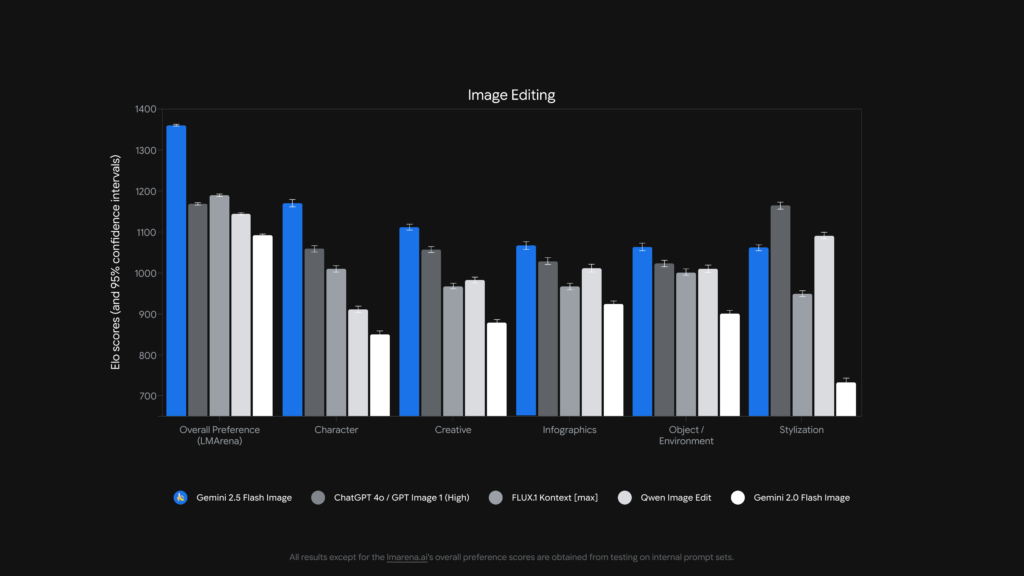
Imagine needing to test a dozen marketing visuals. Instead of hours in Photoshop, Nano Banana generates them in under 30 seconds. In benchmarks like LMArena, it’s rated among the most accurate generative visual models.
Value for Leaders and Creators
For enterprise teams and design professionals, this is not just a toy. Nano Banana enables rapid prototyping, consistent branding, product mockups, and campaign A/B testing, all from text. It truly supports real workflows.
Technical and Creative Control
Google designed this with control in mind. You can ask it to remove an object, restyle a room, or even apply textures from one image to another. It embeds SynthID watermarks, visible and invisible, to signal AI-origin content, addressing authenticity concerns.
Real-World Use Cases
The true value of any AI upgrade lies in how it shows up in everyday work. Gemini’s Nano Banana upgrade isn’t just a technical leap; it’s a practical tool that fits right into business, design, and personal workflows.
Marketing and Branding
A retail brand can upload a product image and try different styles or backgrounds. The subject stays consistent, enabling fast A/B testing in campaigns.
Professional Headshots and Self-Portrayal
Need a polished LinkedIn photo but can’t hire a photographer? Simply upload a selfie and prompt it: “Corporate headshot, neutral background”. Nano Banana delivers a ready-to-use portrait in seconds.
E-commerce and Interior Visualization
Design teams can blend room images with furniture, textures, or color palettes. The AI maintains scene coherence and enables iterative editing until the desired visual is set.
Competitive Landscape
In fair comparisons, Nano Banana often outpaces OpenAI’s ChatGPT-5 image tools on realism, likeness consistency, and speed, sometimes 5–6 times faster. Users cite better fidelity when combining photographs or retaining the same subject across edits.
Meanwhile, Meta, Adobe, and others ramp up their offerings, too. Adobe even provides complimentary access to Gemini’s image generator to Creative Cloud subscribers. Yet few tools match the editing precision and ease of use that Nano Banana delivers today.
Behind the Innovation
At its core, Gemini’s Nano Banana upgrade integrates Google DeepMind’s visual model with Gemini’s world understanding.
Nicole Brichtova, senior product manager at Google DeepMind, emphasizes instruction-following and visual quality. The model also performs multi-turn editing with narrative coherence.
Pricing is accessible, and even free plans support it in the Gemini app. For API usage, enterprise customers pay approximately $0.039 per image.
Balancing Creativity with Responsibility
While powerful, such technology raises meaningful questions. Experts urge caution around misuse, deepfakes, misinformation, and identity misrepresentation. Google embeds SynthID markers in each image; invisible watermarks help future detection, though current tools are limited.
From a leadership standpoint, embracing Nano Banana means also investing in ethical guardrails, internal policy, and audit practices for AI-generated visuals.
A Day in the Designer’s Life
Picture Sarah, a marketing director at a mid-sized retail firm. She needs four product banner variations for an upcoming sale by the afternoon. Normally, she would brief a designer, wait for mockups, and request revisions.
With Gemini’s Nano Banana upgrade, she uploads the product image, types “place on beach background with sunset”, reviews previews, then tells it “swap to white studio backdrop”, all in minutes.
The product stays consistent across all images, the backgrounds change cleanly, and she’s ready to schedule on social media, all before morning coffee. This real-world efficiency transforms how teams work.
Strategic Implications for Decision-Makers
- Adoption Speed: Tools like Nano Banana lower barriers. Non-designers can generate visuals quickly.
- Cost Efficiency: Reduces reliance on external agencies for simple edits.
- Brand Consistency: Maintains visual identity across iterations.
- Innovation Culture: Encourages experimentation across teams, marketing, HR, and operations.
- Ethical Duty: Embedding watermarking, usage policy, and audit traceability becomes vital.
The Future: Where Things Are Headed
Expect deeper multimodal fusion: text, image, voice, and even video. Gemini may soon support video editing with similar fidelity. With developer access via API and Vertex AI, companies will likely build custom visual-generation workflows, dashboards, or end-user apps.
On the research side, we may see tighter watermark standards, on-device detection tools, and stronger bias mitigation. As tools spread, domain-specific mini-models for fashion AI, product design, and architecture will emerge, built on Nano Banana architecture.
Unlocking New Workflows With Gemini’s Nano Banana
Gemini’s Nano Banana upgrade is a leap in AI-powered creativity. It brings speed, consistency, and intuitive control to everyday image editing. It serves professionals, executives, marketers, and creators, unlocking new workflows and efficiencies.
But alongside its creative power, it calls for thoughtful governance. Responsible deployment, combined with imagination, can unlock value while preserving trust and integrity. The Nano Banana upgrade shows us not just what AI can do today, but how creative collaboration between humans and machines will define tomorrow’s visual landscape.
FAQs
1. What makes Gemini’s Nano Banana upgrade different from other AI editing tools?
It preserves the identity of people, objects, or pets across edits using multi-turn prompts. It’s faster and more consistent than rivals, ideal for real-world workflows.
2. Can businesses integrate Nano Banana into their existing tools?
Yes. Google provides access via Gemini API, Google AI Studio, and Vertex AI. Enterprise teams can build custom pipelines, apps, or dashboards around it.
3. Are Nano Banana-edited images detectable as AI-generated?
Yes. Google embeds SynthID watermarks, visible and invisible, in each image. Detection tools are evolving, helping maintain content authenticity.
4. Is there a cost to use Nano Banana?
Basic features are available free in the Gemini app. For enterprise/API use, pricing is about $0.039 per image (~30 ¢ per million tokens), based on usage.
5. How can leaders use Nano Banana responsibly?
By defining ethical policies, training staff, maintaining watermark audit trails, and monitoring distribution of AI content. Encourage creative use while safeguarding authenticity.
Discover the future of AI, one insight at a time – stay informed, stay ahead with AI Tech Insights.
To share your insights, please write to us at sudipto@intentamplify.com.