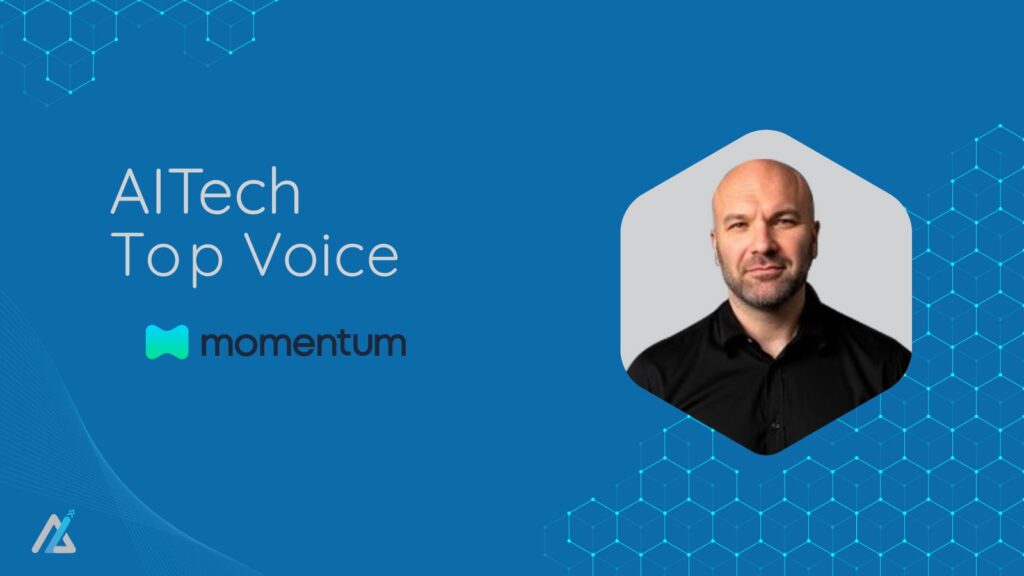

For the latest in our AI Tech Top Voice series, we sit down with Jonathan Kvarfordt, Head of GTM Growth at Momentum.io and founder of the GTM AI Academy. A recognized leader in AI-driven go-to-market strategy and enablement, Jonathan’s journey in AI and GTM strategy blends academic rigor with practical innovation.
Jonathan currently focuses on building AI-driven frameworks that empower teams to accelerate sales cycles, protect their customer base, and gain real-time GTM insights. His experience spans GTM strategy, enablement, AI adoption, and business transformation, making him a trusted voice in the intersection of AI and commercial execution.
About Jonathan Kvarfordt: Jonathan Kvarfordt is Head of GTM Growth at Momentum.io and founder of GTM AI Academy. He combines deep expertise in AI, marketing, and leadership to advise organizations and teach professionals on driving smarter, AI-powered go-to-market strategies.
About Momentum.io: Momentum.io transforms sales and customer interactions into business action, accelerating revenue, improving forecasting, and providing GTM observability across teams. Seamlessly integrating with existing tools, Momentum leverages AI and automation to extract and synthesize data at scale without adding platform overhead. Founded in 2020, leading revenue teams use Momentum daily to capture forecast and churn risk, autofill Salesforce fields, share product signals, and deliver insights at the right time.
Learn more at Momentum.io.
Here’s the full interview.
AI Technology Insights (AIT): Hi, Jonathan. Welcome to the AI Technology Top Voice Interview Series. Please tell us about your current role at Momentum and how you came to be in this position.
Jonathan Kvarfordt: I am deep in the revenue and AI space and have been for a few years. I searched for tools that could help me with my team at the time, and I found Momentum. The first meeting I had was with Momentum’s CEO Santiago, who was a very humble, very intelligent, non-salesy person who just answered my questions and gave me a glimpse into what AI actually looks like when used in a tech that works inside of the revenue team’s workflow.
Since then, I became an advisor, then a consultant, and eventually, I took over marketing and growth in February of 2025.
Recommended: AITech Top Voice: Interview with Court Watson, Partner, Risk and Financial Advisory, Controllership at Deloitte
AIT: What are your key offerings? How do you use AI and ML to improve the overall product development lifecycle for your stakeholders?
Jonathan Kvarfordt: Momentum, at its core, is an orchestration platform with deep integrations into revenue teams’ tech stacks, such as Salesforce and Slack. We were one of the first to not only adopt AI but also the first to create auto-generated summaries of calls, which are now very common. Currently, we leverage several models for customers inside the tech, such as OpenAI GPT’s latest models, Anthropic’s Claude, Google’s Gemini, Cohere, and more.
AIT: We celebrated the AI Appreciation Day on 16 July. What message do you have for the AI industry– who have ethics and data privacy concerns evolved in the last 2 years?
Jonathan Kvarfordt: At Momentum, we take security and data privacy very seriously. We have Zero Retention Data agreements with any AI technology we use, along with SOC2, GDPR, and other compliance measures.
AIT: Momentum has positioned itself as a leader in Agentic AI for revenue orchestration. Can you walk us through what “Agentic AI” means in the context of real-world sales and customer success workflows?
Jonathan Kvarfordt: Everyone has different definitions of what Agentic means.
For Momentum, we put it on a spectrum of how much the AI is doing without human interaction involved and making decisions on its own.
For example, it’s like our new product SmartClips, where you allow the AI to decide what part of a video fits the criteria you are looking for, and it then clips the video for you.
In another example, Momentum can identify if all the required fields of a sales stage in Salesforce are filled in, and then move those stages by itself. Or, we can let the human in the loop decide when to move. It is all about how much decision-making power you want to give to the AI or not. Momentum adjusts to the comfort level of both the team and company.
AIT: Tell us more about your AI initiatives in the US market. How are you planning to scale the AI research at Momentum to supercharge revenue ops management for the lagging industries when it comes to adoption and maturity?
Jonathan Kvarfordt: At Momentum, we pride ourselves on having some of the best talent in the business who are truly passionate about using the best models and technology available to improve our products. That said, not every model is best for every task. We conduct extensive testing processes to ensure that the customer’s needs are being met first.
Ultimately, we are determined to push AI to its limits and do things that no one else has thought of.
AIT: What differentiates Momentum’s approach to revenue orchestration from other platforms in the space?
Jonathan Kvarfordt: There are many things, but our biggest differentiator is our depth of knowledge in the problems our customers experience. We tailor the depth of our integrations to match this. For example, Momentum can automatically update 98% of any updateable field in Salesforce, whereas others can only do up to 30-40%. That gives us incredible ability to capture more data, powering more AI Agentic workflows and automation better than anyone else.
We are also able to create business action items, not only from the data we provide from customer interactions, but also from other data feeding into Salesforce from third-party vendors, a company’s own product usage, etc.
With Momentum, any relevant data that needs to be used to move the company forward is leveraged to its fullest capacity, without relying on a human to do it.
Recommended: AITech Top Voice: Interview with Hafiz Lockman, U.S. Country Director at Telekom Malaysia
AIT: Why is integration with tools like Slack, Salesforce, and Microsoft Teams so critical to the success of your platform?
Jonathan Kvarfordt: These tools represent the best in the business and what we find to be the industry standard that most teams operate within daily. Our mission was not to be another technology to adopt, but to be one that easily integrates into individuals’ workflows and reduces friction so they could focus on what matters, which is the prospects and customers. These integrations are key to make sure we hold true to that vision.
AIT: Can you share a real example of how a customer used SmartClips or Account Briefs to improve their pipeline or reduce churn?
Jonathan Kvarfordt: Both of these products were built to solve some key issues we kept hearing about in the marketplace.
For SmartClips, the need was for digestible, quick video snippets, beyond just the text, so teams could see conversations in real time regarding competition, product feedback, and best practice sharing for teams with coaching.
Prior to Momentum, I was in enablement for a decade. I remember having to spend hours finding the clip and editing it to share with the team. Now, it’s done for me immediately after every call.
Being able to share that content faster accelerates and helps save deals every single day.
AIT: What major trends in AI do you believe will shape go-to-market strategies over the next 12 to 18 months?
Jonathan Kvarfordt: With the progress of MCP and other capabilities of AI to communicate across different technologies, I believe there will be a moment where some well-established SaaS companies will cease to exist because they are holding on to the old world.
The first thing I see is a major reckoning of tech that will be unwilling to change. On the flip side, the teams and tech that are AI-native and adopt the capabilities of AI will find themselves accelerating faster and becoming leaner than ever.
With the progress of AI, I believe that in-person events will become more important than ever. As AI gets to do everything and be everywhere, people will want to connect with people more often.
AIT: What advice would you give to revenue leaders trying to adopt AI tools without sacrificing the human side of selling?
Jonathan Kvarfordt: The first question revenue leaders should ask themselves is:
What does your customer want with a buying experience?
At Momentum, we believe that the human is positioned at the center of both client relationships and excellence, so everything we do is to augment the human instead of replacing them.
With that being said, there are so many tasks or low-value processes that can, and should be, automated with AI so that sellers and customer success professionals can do more of what they want and are good at.
AIT: Tag a person in the industry whose answers you would like to see in the AITech Top Voice interview series:
Jonathan Kvarfordt:
Thank you so much for your time today! We look forward to having you again at our Top Voice Series.
Recommended: AITech Top Voice: Interview with Chon Tang, Founding Partner at SkyDeck Fund
To share your insights, please write to us at sudipto@intentamplify.com